How to Unclench

written by Jonny Miller
I’ve spent the last five years teaching nervous system regulation to 1,500+ students: CEOs of rocket-ship startups, Broadway stars, firefighters & busy parents of five.
I’ve realised that everything I teach distills down to one word.
Unclench.
I’m not kidding.
Most human struggles are downstream of clenching: anxiety, burnout, overwhelm, addiction, procrastination, feeling stuck or even reactivity in relationships.
And if the upstream cause of our suffering is clenching, the way out is learning how to unclench.
It is absurdly simple.
What I've witnessed on the other side is moving: the creative describing seeing her world in high definition for the first time, the father catching reactivity with his daughter earlier, the wife sitting down to have the tough conversation she’d been avoiding.
Part I of this essay explores the pain of clenching, why we clench and the joy that arises when we unclench.
Parts II–IV show you how to run unclenching loops, avoid the inevitable pitfalls, and recognize progress over time.
Let's dive in.
· · ·
1. The Pain of Clenching
In 2001, Scott Boswell was seven years into his professional cricket career, enjoying one of his best seasons yet and gearing up for the biggest match of his life: a cup final at Lord’s.
"It was," he told a journalist, "going to be one of the best days of my life."
The night before, his coach told him, “Don’t fuck up.” This buried into his mind, and during his first over (for American readers, this is like pitching in baseball) he noticed his muscles start to clench. His fingers became so tense that he wasn’t able to release the ball.
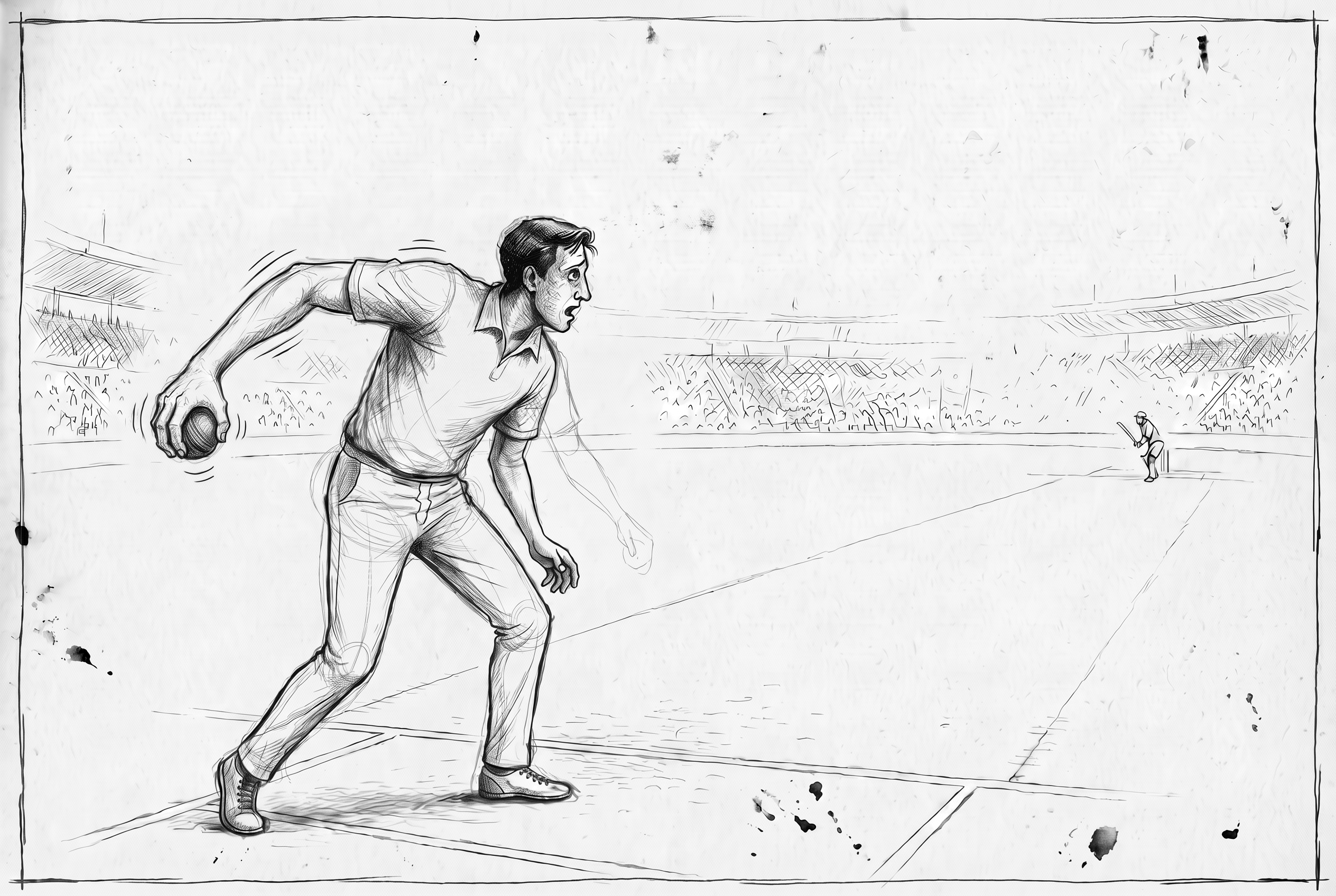
The next over, he bowled wide. His muscles contracted tighter still, attempting to shut out humiliating jeers from the crowd.
He bowled wide again, and again, and again eight more times… his mouth was dry, he felt like he couldn’t move. By the end, he was barely able to walk three meters to pick up a water bottle and asked his teammate to fetch it. It was one of the worst bowling performances ever recorded on live television.
Boswell was sacked by his club days later, fell into a depression, turned to alcohol and spent the next ten years recovering.
· · ·
This is an extreme case, and likely you’re not a professional athlete, but what has clenching cost you in your life?
I don’t mean just physical discomfort (although that might be present) but what opportunities have you squandered due to clenching?
I’ve heard stories from students who defensively said words he didn’t mean that ended a great relationship, one whose small intestine tightened like a ratchet as she wrote a resignation letter that didn’t get sent, or an ambitious post-doc whose throat constricted with anxiety during a job interview.11
If you pay attention, in the moments when you are procrastinating on an important task, saying something your future self will regret or compulsively over-thinking, you are almost certainly sitting at the clenched end of this spectrum.22
And it’s not just the major moments — clenching impacts in subtle ways. If you’re anything like me, it looks like over-thinking a text reply, holding my breath whilst replying to email (so-called ‘screen apnea’), refreshing my Instagram feed, or overlooking creative third doors that would have unlocked serendipitous opportunities.
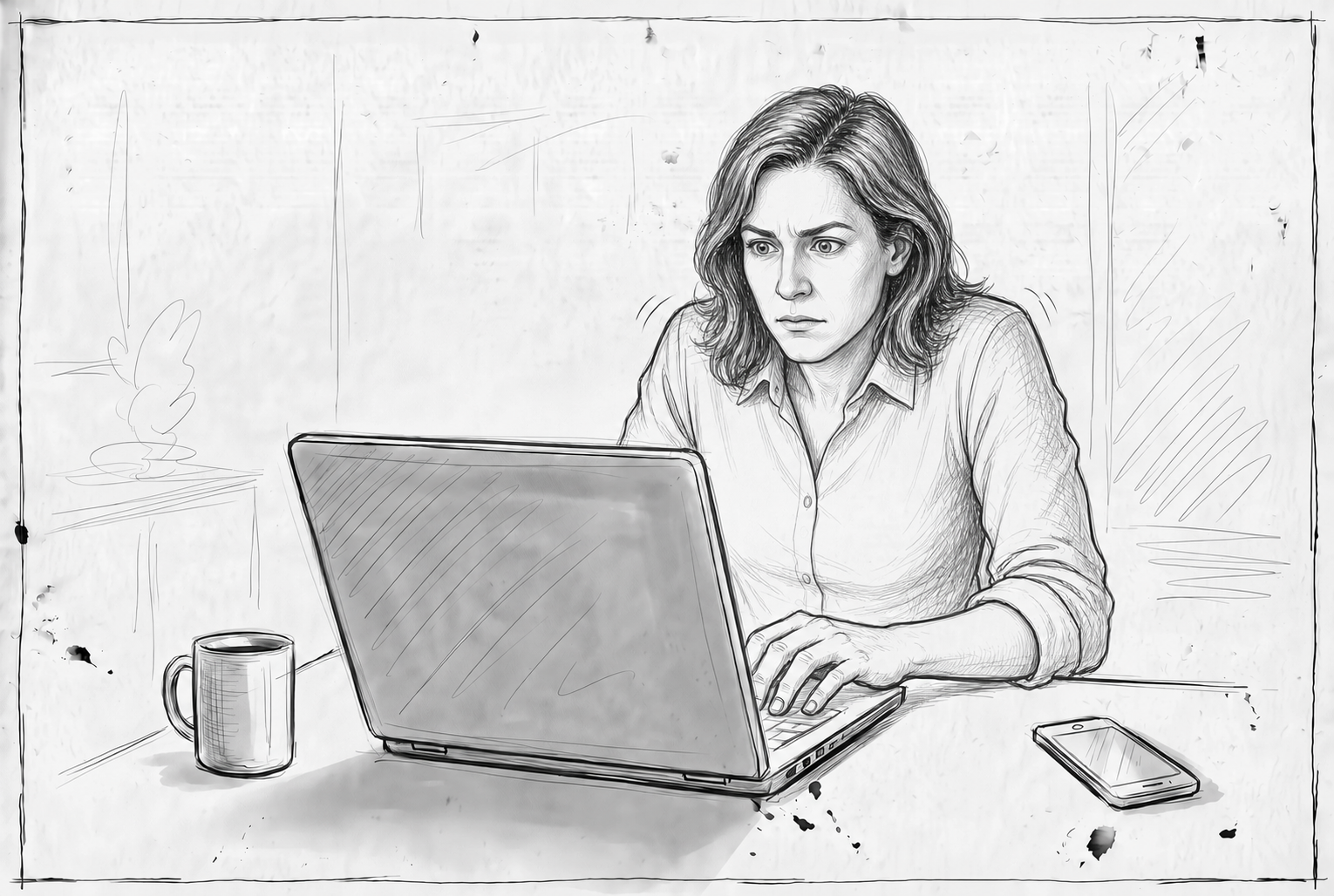
I received an email recently in which the self-aware sender described his default clenched state in the following way:
"One of my biggest struggles is what I can only describe as the castration of my agency. The ultimate contrast is that I have an MBA, yet I’m driving a bus, which, as you likely know, is perfectly logical from the perspective of a stuck nervous system. My capacity is there, but my system won't let me access it."
I hear stories like this all the time. Perhaps what was most painful for me personally, I remember walking into a subway station in London feeling like a zombie, out of touch with any spark of aliveness, as if there was a pane of glass between my life and my actual experience of life.
And as Annie Dillard once wrote "How we spend our days is, of course, how we spend our lives."
At this very moment you are sitting somewhere on this spectrum, from clenched to unclenched. And the more clenched you are, the fewer options you will perceive (see the interactive slider below)
Once you start noticing it, you can’t un-see it.
If you’re experiencing any kind of physical pain, bracing makes it worse. If you’re watching someone’s voice go high on stage while their posture stiffens, yep, that’s clenching nuking their charisma.33
The more you pay attention, the more you’ll notice that it’s difficult to feel anything at all when you’re clenched.
Try it for yourself as you’re reading this: deliberately clench your entire body like you're trying to vacuum-seal yourself from the inside. Now, try to feel an emotion: joy, pleasure, or anything at all.
You almost certainly won’t be able to. That’s because clenching drastically reduces the range of options and feelings available. In other words, clenching dulls your aliveness and reduces your perceived options.
Here's Oliver Burkeman, author of Four Thousand Weeks, describing his experience of the clench tax:
“Clenching seems to be my default response to uncertainty or overwhelm or other difficulties to tighten up against them so as to hold them at bay – when in fact that leads only to paralysis and a sense of sterility.”
· · ·
2. Clenching Is a Prediction
What is clenching? If we do it so much, surely there’s an adaptive reason?
Try this thought experiment: imagine an alien neuroscientist studying your behaviour on an ordinary Tuesday. He understands little about human culture, but he knows that mammals contract their muscles when preparing for danger.
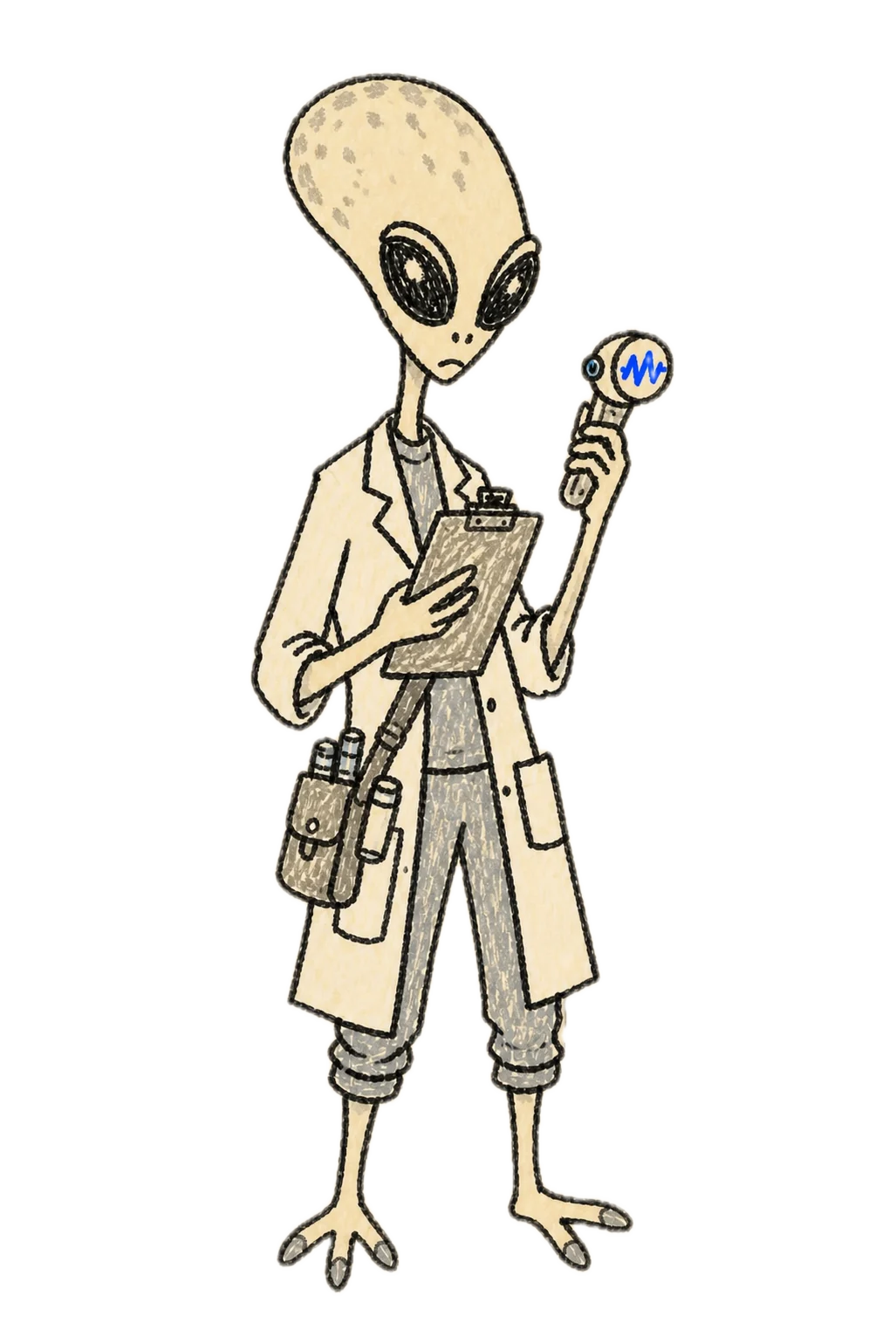
His field report might read something like:
8:12 a.m. Repeated threats detected from a glowing rectangle.
10:43 a.m. Defensive contraction observed in proximity to another member of the species.
4:57 p.m. Muscular defenses activated anticipating critical feedback, apparently preparing to be punched by the future.
He might conclude that Earth is perpetually hostile. Alternatively, he might wonder why human physiology defends itself in absence of an external threat.
There is no formal scientific explanation of what causes these muscular defenses, even experienced meditation teachers find it hard to define. That said, clenching is best thought of as the biological system making a prediction – shrinking the uncertainty aperture on your experience to reduce overwhelm – like sketching a map of a perpetually shifting sensory landscape.44
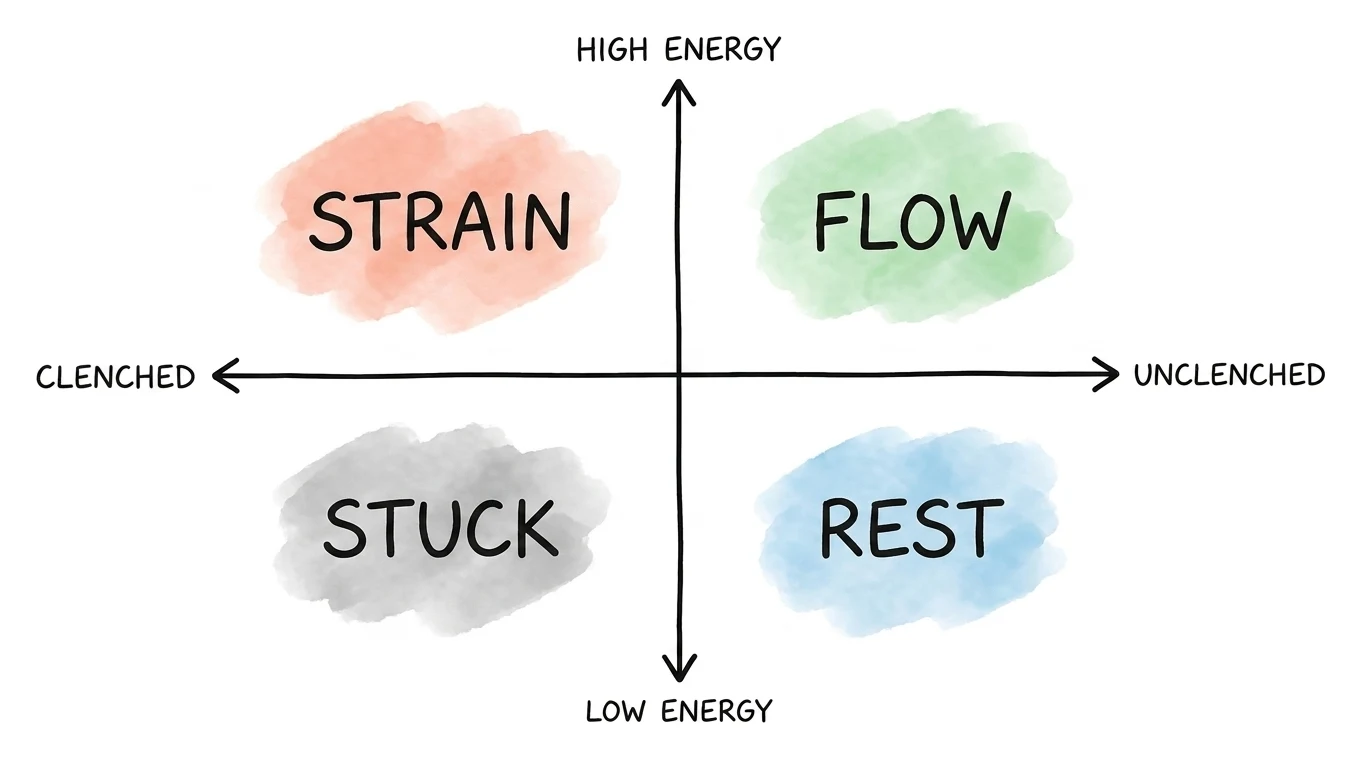
At this point, you might be wondering whether ‘unclenched’ is simply another word for ‘relaxed’. Pay close attention, however, and you can see them as different dimensions: you can be in a deep parasympathetic, low-arousal state (a fancy way to say relaxed) while remaining highly clenched (e.g. depressive or freeze states), or perhaps a glass of pinot will help you unclench, but you might not be lower energy.
You can also be in a high-energy + unclenched state: this is where we typically experience creative flow, pleasure or expansive states like awe and wonder.
Open the theoretical neuroscience rabbit hole A speculative model outlining how clenches get stuck and a proposed mechanism for how trauma is stored in the body
The most compelling explanation I know of comes from theoretical neuroscientist Mike Johnson, whose vasocomputation model proposes that vascular clenching allows your nervous system to physically hold a prediction in place.55
In a recent paper, neuroscientist Ruben Laukkonen tracked brain dynamics during unclenching and showed that unclenching practice (the researchers called it ‘effortless awareness’) leads to what can be measured as ‘criticality’ on the level of the brain. Ruben describes this as:
“A system at criticality is exquisitely poised: neither rigid nor chaotic, neither stuck in what it was nor dissolving into noise. It is maximally sensitive, flexible, and synergistic. It efficiently processes what comes next”
One interpretation is that clenching opposes this flexible, sensitive, flow-like state. We have already made up our minds; our thinking has hardened; we no longer look for a third door.
When I was a kid at school, there was a teacher who was teased for ‘having a stick up her butt’, it wasn’t kind, but they were accurately observing that she had physical tension and also overly rigid beliefs.
Clenching swaps flexibility for short-term stability. By stiffening the body and narrowing available responses, it makes uncertainty easier to manage.
This offers a biological mechanism for the old idea that humans prefer the certainty of misery to the misery of uncertainty.

Some clenches last only a moment, like a flinch. Others become habitual: the same protective response comes even after the situation has changed.
According to Mike's theory, there are two different types of clenching:
Short-term clenching: vascular smooth muscle constricts, reducing circulation to nearby neurons and their capacity to update.
Long-Term 'Latches': When a clench is held for long enough, the smooth muscle tissue glues itself into a contracted state (latch-bridge mechanism), a state that could last for days, months, or even decades. Partial contraction becomes the new default.
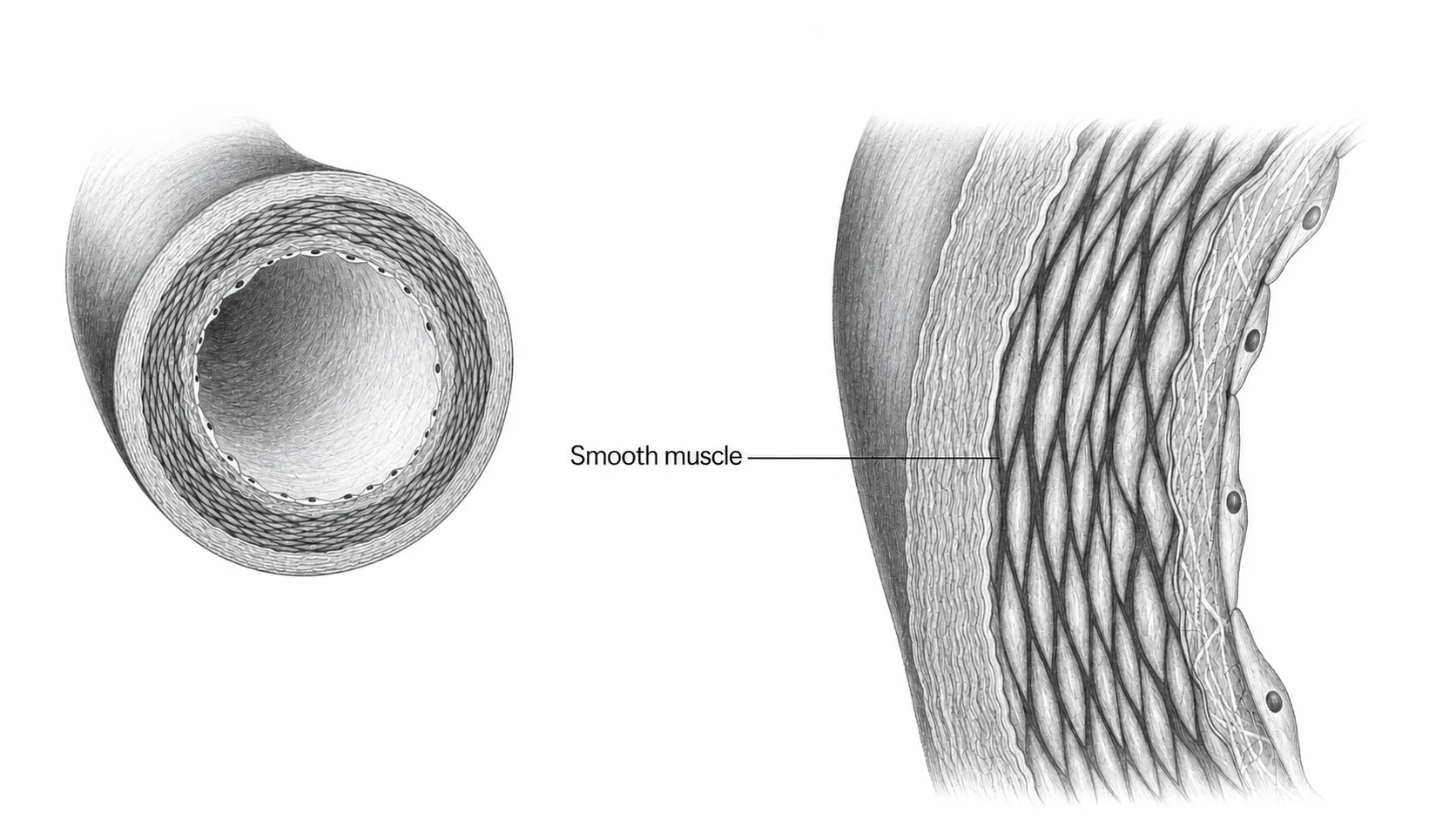
These latches can cause numbness or greatly reduced sensation because the tissue receives less blood.
Latches are harder to release because muscle tissue has been chemically glued into a contracted state. Mike hypothesizes that this is how trauma is physically stored in the body.
It’s likely that addictive substances hook us precisely because they temporarily unclench the vascular system, and people come to depend on that relief.
· · ·
3. What Does Clenching Protect Us From?
TL;DR: clenching is an emotional discomfort avoidance mechanism
∼∼
Clenches often show up as protective behaviour: a perfectionist guarding against critical feedback might hold a tight jaw and neck (though the mapping varies from person to person).
Back in the 1930s, Wilhelm Reich called these patterns ‘character armor’ (his student Alexander Lowen later sorted them into five structures): ‘typical character attitudes, which an individual develops as a blocking against their emotional excitations’66
Here’s another surprisingly deep question: why can't I just decide to unclench when I want to, in the same way that I can choose to unclench my fist? @dfwtee expresses this frustration in an unironically clenched fashion.

Your body is making the adaptive choice.
For example, if, like me, you got angry at teachers as a kid, you were likely punished. Or if you cried on the playground, the other kids teased you.
Because we are social mammals, both experiences can lock in an adaptive clench. The next time anger or sadness arises, we associate this with bad things, so push it back down to avoid more punishment.
Most people have never fully experienced an emotion without clenching against it. If I could put one idea on a billboard for a billion people, it would be this:
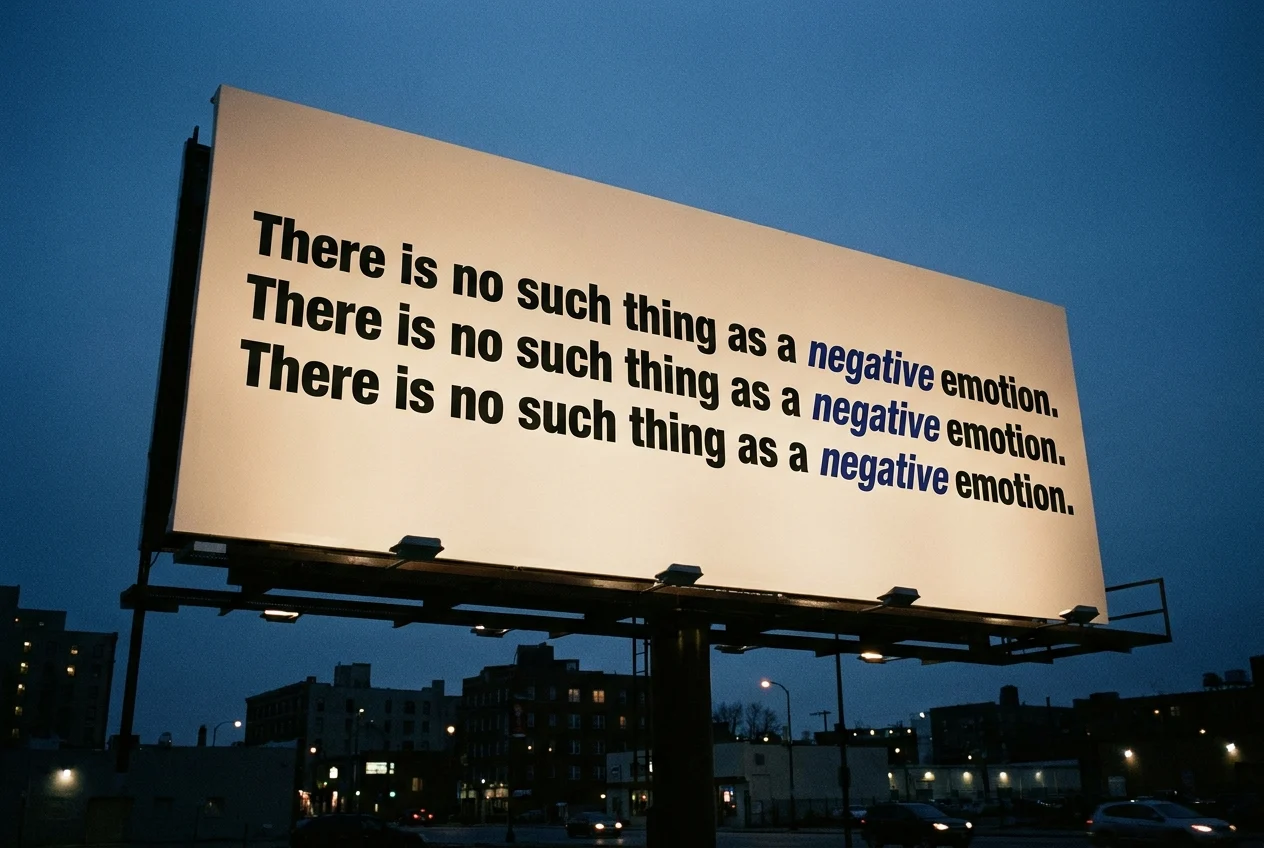
Feeling a feeling isn’t what makes an experience unbearable. Our suffering comes from clenching against what we feel.
There is a word for clenched excitement: fear.
You can run the experiment for yourself. Next time you’re afraid of something, raise your hands above you like you're celebrating and hop up and down on the spot. Exclaim “I’m excited, I’m excited, I’m excited,” five times and notice what happens.
There’s a whole section coming on how to unclench, but if I was to distill it down to a single question it would be:
‘If you couldn’t feel clenched right now, what emotion would you have to feel?’
Here’s an example of what this looks like when emotion surfaces from beneath the clench (bodyworker Garry Lineham working on LeAnn Rimes)
Here are five specific examples of common behaviour patterns that arise due to clenching, along with the emotions that are being resisted against, and the ‘brilliant logic’ that keeps the strategy of the clench in place.
I viscerally remember the first time I experienced what it was like to deeply unclench into an intense emotion.77
Back in 2017, my former fiancée took her own life by overdosing on her anti-anxiety medication. As I was walking towards her memorial bench on a windy pebble beach, I could feel a flood of grief about to roll through, as if triggered by an avalanche upstream of my consciousness.

I sank onto my hands and knees and allowed myself to be taken by it. Contrary to what I had anticipated, the grief didn’t crush me. Instead, it opened into an overwhelming, primal sense of loving interconnectedness.
At first the experience confused me. I believed that grief was simply bad, yet what I felt was deep love and raw aliveness.88
· · ·
4. Feeling Good is Our Default State
So if clenching leads to making decisions that you will likely regret later, then how do you become someone your future self will thank you for?
The mechanics of feeling really good are weird. You may believe that parts of your life need fixing because you don’t have enough money or the right partner. That story comes from cultural conditioning: an idea that we must somehow earn the right to feel good.
By now it’s a trope: a founder sells their company and falls into an existential crisis, or an Olympian wins gold and sinks into depression.
Fame and success simply amplify one’s internal state. Putting more points on your scoreboard of choice rarely creates lasting contentment. Or as Jim Carrey put it:
“I think everybody should get rich and famous and do everything they ever dreamed of so they can see that that’s not the answer.”
So what is the answer to lasting contentment and happiness?
Philosophers have debated this for thousands of years, but I believe there is an answer, one that runs counter to what most people believe.
The default Western view is that feeling good must somehow be earned by adding things to your life. However, it is my direct experience that feeling good is our default state when we remove the clenching.99
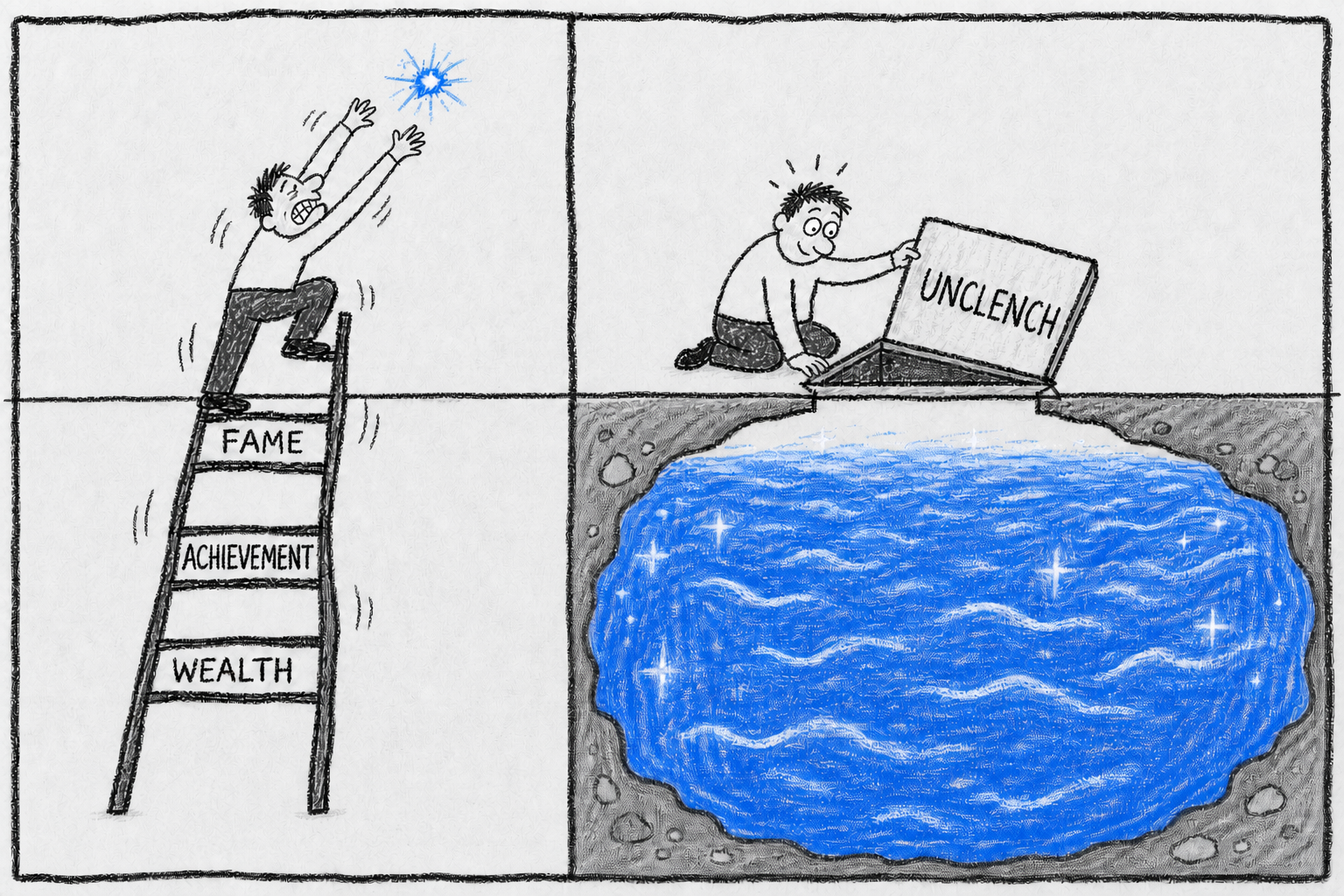
This simple practice raises the ceiling of happiness far higher than most of us imagine. The experience of deliberately unclenching feels like sliding into a deliciously-toasty Japanese onsen with an expansive view that you can’t help but go ‘ahhhhhhh’.
Dedicate a few hundred hours to the practice and your baseline of happiness becomes not a little higher but, according to serial unclenchers like Nick Cammarata, 30–50 times higher. And these unclenched states can become default traits.
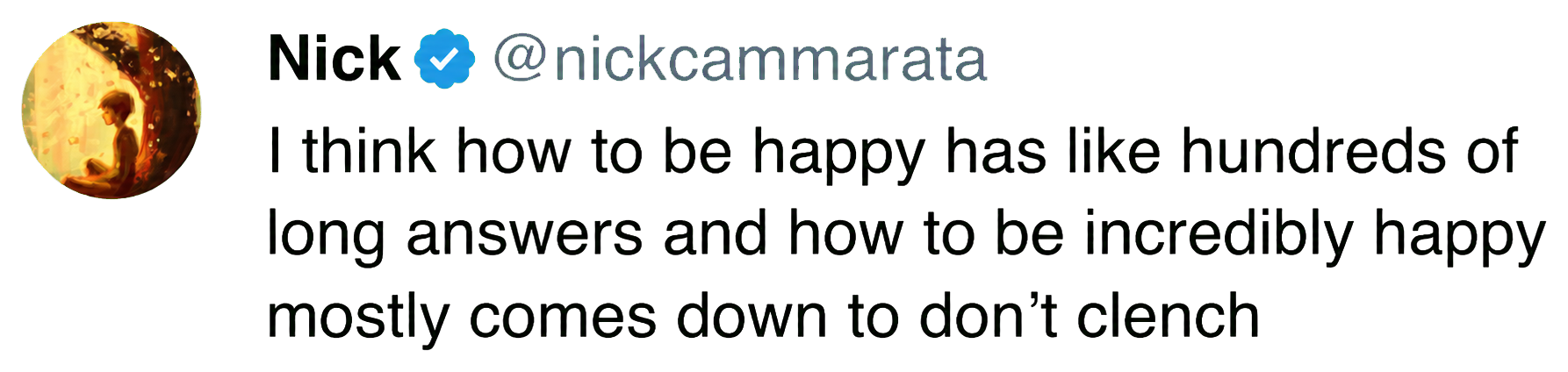
I’ve also noticed that unclenching seems to cultivate the virtues I care about: courage, kindness or discernment.
This is because there is no longer a scarcity mindset around feeling good. If you truly believe in your ability to relax into a sense of fundamental wellbeing, then you stop managing the world around you to make you feel a certain way.
You may be feeling some healthy skepticism. It’s an enormous claim, and language often fails to convey the scale of an inner experience. Here’s an exchange between Shinzen Young and a student who asked whether his practice was worth the effort.
· · ·
If I was given the choice of living one more day experiencing life the way I experience it, or living 20 more years as a wealthy, healthy, celebrity sexual athlete, beloved by everyone but not experiencing what I experience (vis a vis enlightenment), the decision would be a no-brainer--I'll take the one day of enlightened living. IT'S THAT GOOD, DUDE.
All the best,
Shinzen
· · ·
II. The Unclenching Loop
If you only take away one thing from this essay, let it be this: unclenching is a trainable skill.
If you run self-guided experiments and track what you learn (I call these loops), you will almost certainly make real progress over time.
No one taught us how to unclench. Self-help offers clichés such as ‘Let go or be dragged’ and ‘What you resist persists’, but there aren’t many practical guides out there. That said, most people get the hang of it pretty quickly.
I offer these practices with a caveat: unclenching is not yet a hard science. But we do need one.1010
One counterintuitive principle: intensifying a clench and cycling through clench and release seems more effective than sending a single ‘release’ signal.
You can try this by following your breath. Pay close attention and you may notice a slight clenching on the inhale and softening on the exhale. After a few minutes, the breath often becomes quieter and the exhale easier to release.
1. Run Your First Loop
In AI, loops optimize a system. In research, loops run the scientific method. Here, the same logic applies to your mental and emotional life.
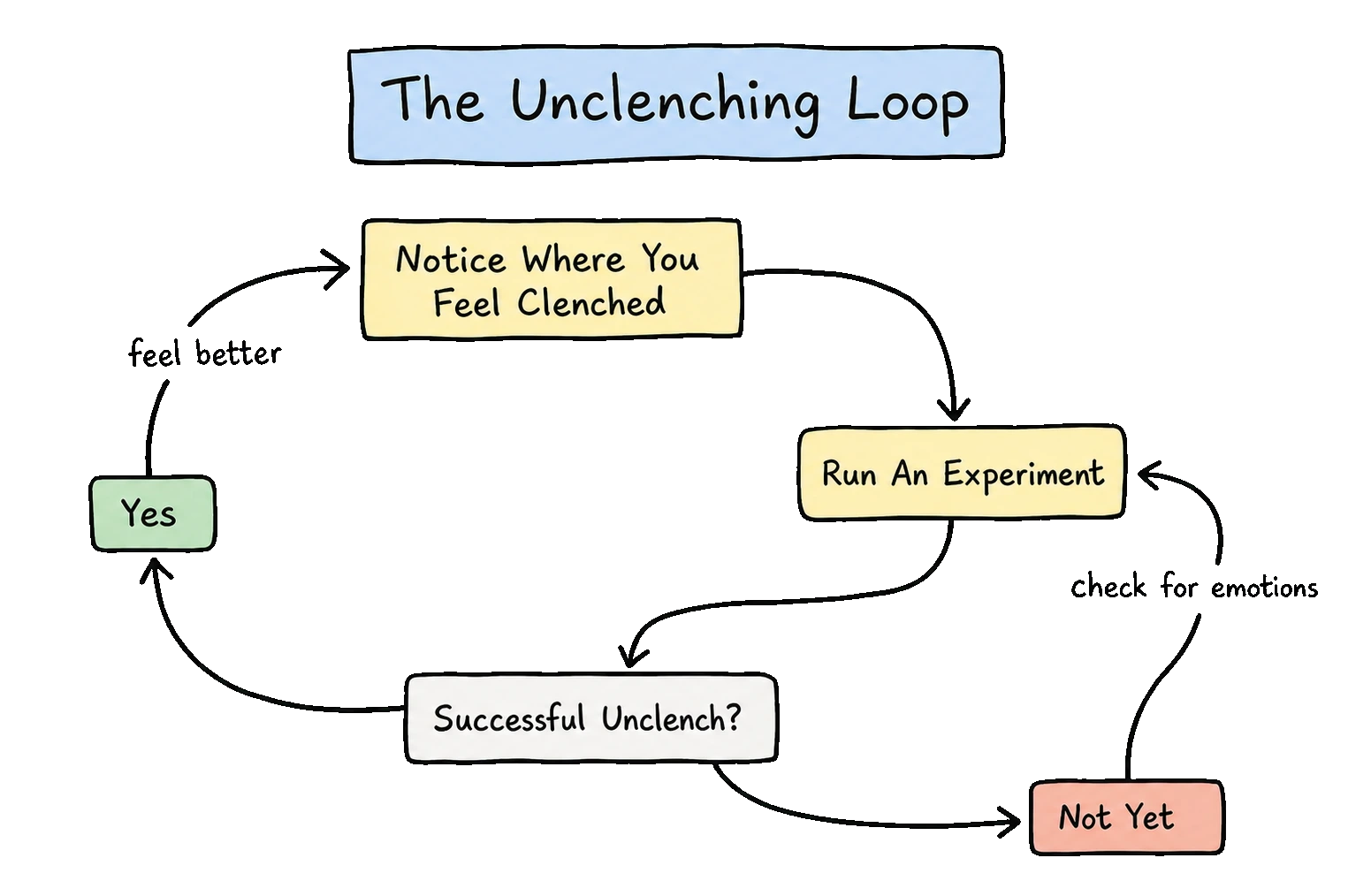
Try the 60-second unclenching loop Five simple steps to notice what unclenching feels like in your body
Every loop has the same four steps: notice a clench, try a move (soften it, or tighten and release it), track what changes, then keep what worked and drop what didn’t. Here's a basic loop you can run in 60 seconds.
Make a clenched fist with your hand → unclench/open it → notice how that feels.
Hold your hands up on either side of you, so you can just about see them in your peripheral vision. Relax your gaze and then very gradually move them backwards until they fade from your view.
Drop your lower jaw away from your upper jaw by about one-eighth of an inch so the teeth aren't touching.
Notice a different part of your body that feels tight (maybe the face or belly) → see if you can relax in the same way.
Hang out here, track how you feel and whether you spontaneously yawn or sigh, which indicates that your system is unclenching.
As you learn the basic moves, you can continue to look for increasingly subtle layers of clenching (eventually also including your perception and awareness) and run experiments when it doesn't come easily.
2. Self-Exploration Mode
Just like sleep, you can't force it (this is another type of clenching), but you can create the conditions for unclenching to arise.
Parts of your brain (specifically the ventromedial prefrontal cortex (vmPFC) and hippocampus) constantly track signals of safety inside and outside the body. Psychedelic researchers call this ‘set and setting’.
The common thread with all of the experiments below might be summarized as 'cultivating a secure attachment with reality'.1111 In plain English: teaching your body that nothing bad happens when it stops bracing, especially in uncertain moments.
I once noticed that I felt clenched about a big decision I would need to make in a few months. After some self-reflection, I realized that I didn’t trust my future self to figure it out when the time came. Once I saw that and relaxed into self-trust, the clenching and anxious thought loops faded.
As you clench less, you become more curious. The aperture of experience opens up because you make fewer assumptions about what your senses are telling you.
Or you can run this quick experiment for yourself: notice how your body feels when you state a belief you’re certain about. Complete the sentence “I know for sure…”
Now imagine you have been parachuted into this moment from another planet. Forget what you know about yourself, where you are, and where you came from. Read these words without prior expectations or beliefs. The more sincerely you enter a state of wonder, the less clenched you may feel.1212
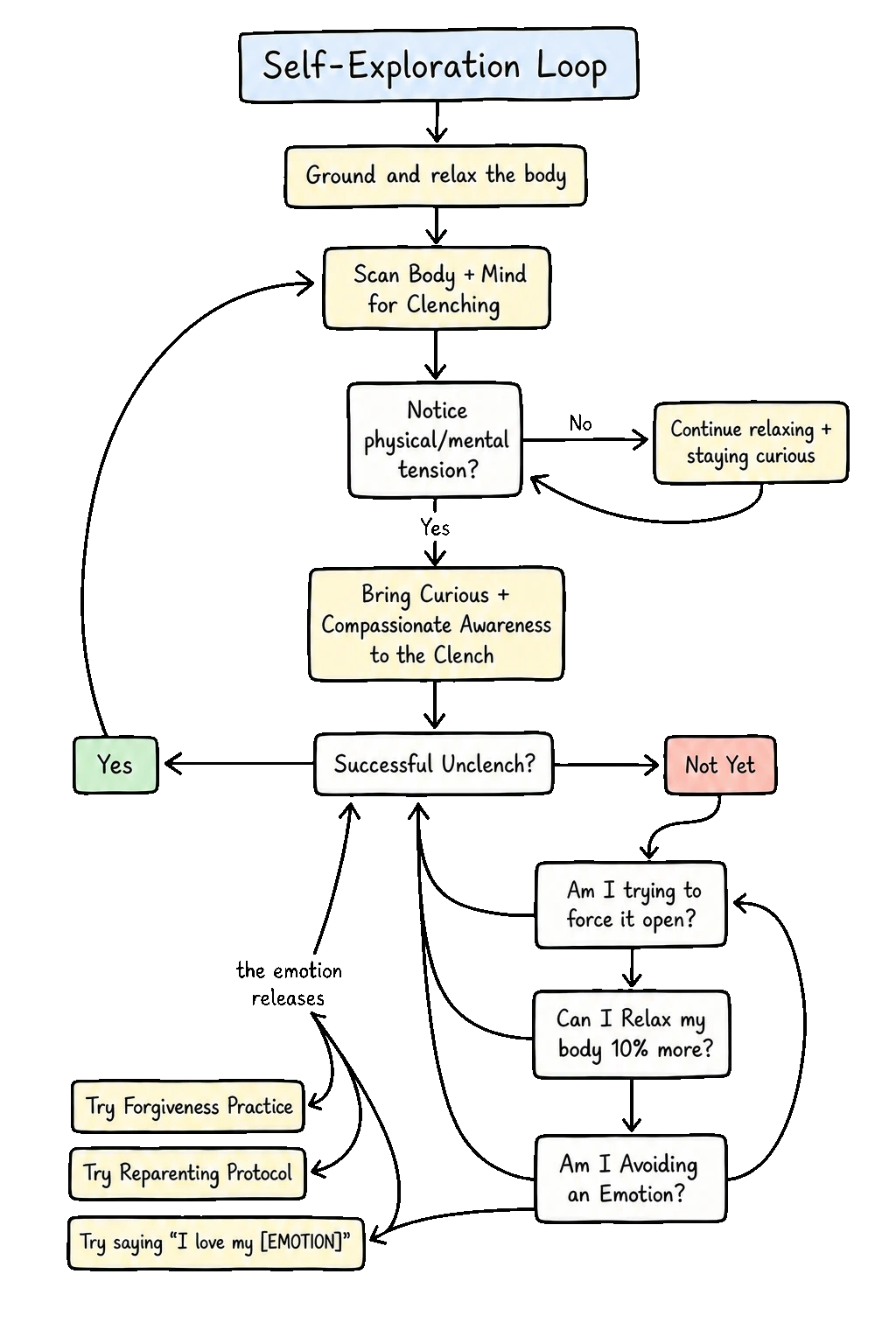
One helpful starting point is:
‘Curious attention will dissolve your tension.’
Alongside curiosity, four other qualities help with unclenching.
The acronym I created for them is CRISP: Curiosity + Relaxation + Intimacy + Safety + Playfulness.
Say each word to yourself and notice what it feels like to inhabit that word fully. What are the sensations associated with each word? Then cycle through the five words at a pace of roughly one word every minute or two.
You can also use questions to dissolve mental clenching. For example, set a timer for five minutes and ask yourself: "Who am I when there is no problem to solve?"
You might notice yourself spontaneously sigh or readjust your posture when a vigilant part unclenches.
You will likely find that the sensation begins to shift or move. If it does then gently track or “surf” it, staying present with the feelings as they arise.
Allow the process to unfold and view your own role as learning how to get out of the way and undoing any active efforting in the process.
You can also invite your awareness to shift away from any story or thoughts (although they will likely still be there) and move the spotlight of your attention to sensations inside your body.
Perhaps you feel queasiness in your lower belly, or tightness in the band around your diaphragm (below your rib cage). Maybe you sense tingling in your chest, neck, and throat area. Focus on an area that feels like it has the most aliveness or contraction.1313
If you sense there might be an emotion present you can try listening to either the somatic surfing or the reparenting protocol guided sessions below.
Tap or click one of the cards below to try one of the guided practices and experience a micro-unclenching for yourself.
Swipe to explore · Tap to open
3. Unclenching in Human Connection
Playing the unclenching game both reveals clenches more quickly and makes them easier to soften.
When I argue with my wife, good intentions and questions of fault become irrelevant if I’m clenched: I know the conversation will end badly. Most arguments amount to two people saying, ‘I’m clenched, and it’s your fault.’
When I relax my defensive stance, however, the argument often resolves into deeper connection than we had before it began.
Outside active conflict, connection lets us borrow calm from another body. In one study, researchers put 110 people under threat of electric shock: alone, they clenched; holding a stranger’s hand helped little; holding the hand of someone familiar made a big difference. Co-regulation allows us to borrow nervous system safety from another.
At the most basic level, you can experience this when you hug or cuddle a partner, close friend or even a pet: you will notice yourself almost instantly unclench.
After a tough day, or when I have clenched myself into functional freeze, a few minutes of spooning with my wife brings me back to myself. This gift is usually more effective than words.
Across nine cohorts of Nervous System Mastery, we’ve found that students who report life-changing outcomes are almost always those who engage in our Relational Dojo practice. This practice can be summarized as unclenching while in connection with another.
There are several flavors of structured human connection loops.1414
They all follow the same principle: practicing with another person makes unclenching easier and more sustainable.
You can also vividly imagine someone you care about, wish them well, picture them thriving, then intensify the image and the feelings it evokes.
I personally prefer practicing in person when possible. However, I've been pleasantly surprised by how powerful practice over Zoom can be.1515
Why is human connection so powerful? In part, because it helps shame dissolve, and shame is often what keeps a clench in place. Take a look at the famous Good Will Hunting scene below, where Sean stays connected with Will until Will’s clench opens and he makes contact with the grief beneath it.
Connection also reduces a core pitfall of self-exploration: it is surprisingly easy to bullshit yourself without external feedback, and eventually you reach limits of exploring solo.
4. Laughter: An Ancient Unclenching Technology
A friend of mine says that "you can tell how much work someone has done on themselves by the depth of their laughter." Anyone can tell the difference between nervous or awkward laughter and a full, hearty belly laugh. The latter has less tension, less clenching, less defending.
Unsurprisingly, laughter involves cycles of clenching and releasing tension in the body. If you think of someone who is taking themselves too seriously, you will probably picture a curmudgeonly man in a tight suit with RCF (resting clench face).
By contrast, someone like the Dalai Lama seems moments from laughter. I can’t verify this, but I would bet that his belly ranks among the world’s most unclenched.
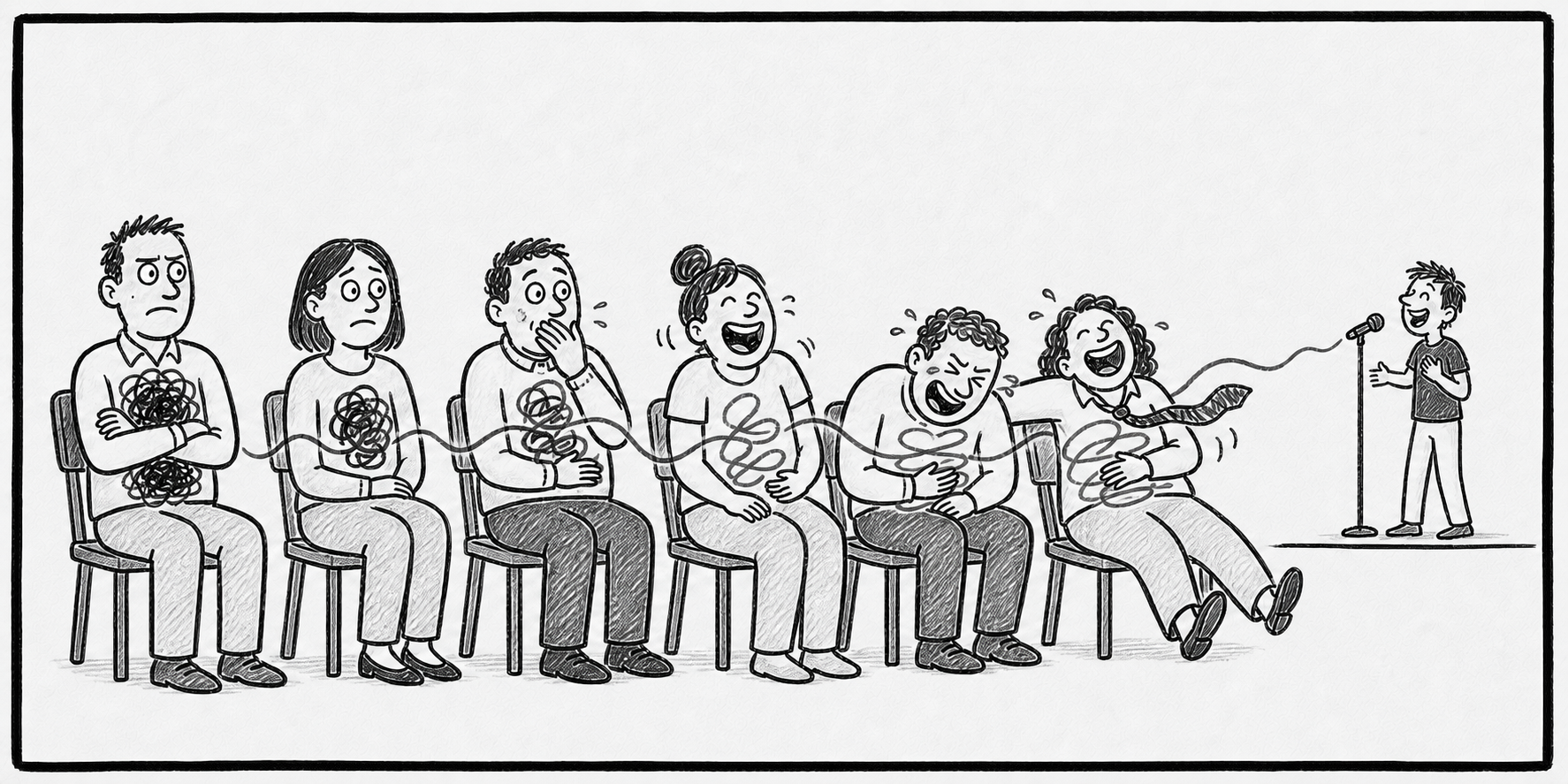
Also, consider stand-up comedy: hundreds of strangers paying one person to trigger involuntary spasms of the diaphragm. My suspicion is that the enormous comedy industry is, among other things, a cultural technology for collective unclenching.1717
· · ·
5. Leverage Temperature Change
Temperature change, often called contrast therapy, efficiently creates the conditions for unclenching.
In Finland, there are an estimated 2.4 million saunas for 3.28 million dwellings. That's one sauna for every 1.4 homes. (probably not unrelated that Finland ranked #1 in the World Happiness Report for the ninth consecutive year.)
The Finns have a word for the steam that rises when water hits the stones: löyly, from an ancient root meaning breath. An old proverb says to behave in the sauna as you would in church. By the third round, your system has a vivid experience of completing an activation cycle. The heat stimulates vasodilation (blood flow) + exertion followed by cooling and a parasympathetic rebound.
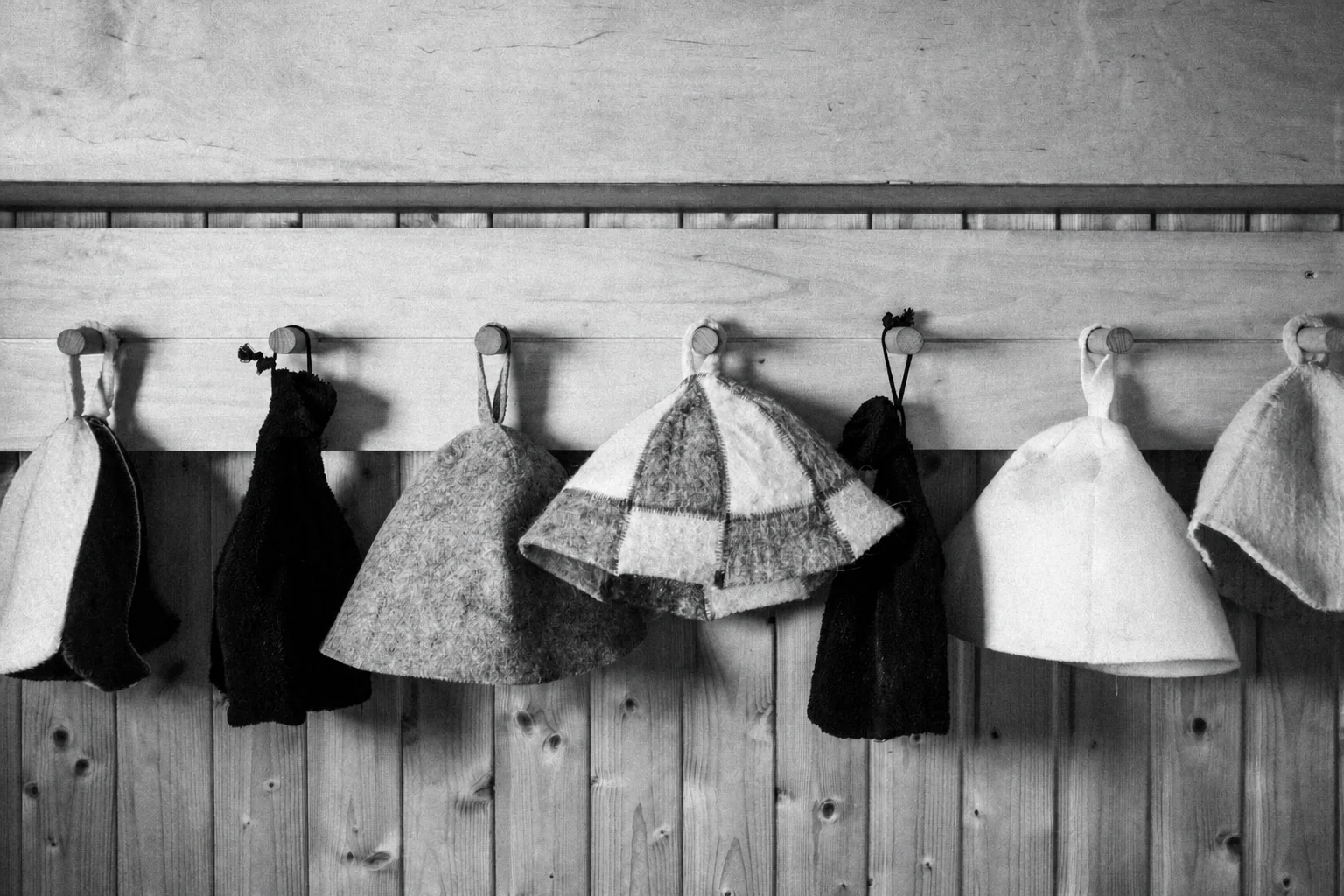
You can amplify the effect by actively unclenching during hot-cold rounds. After a cold round, sit, remain as still as possible, close your eyes, and unclench. The experience can become psychoactive and deeply enjoyable.1818
III. Unclenching Traps
1. The Trap of Not Feeling Much
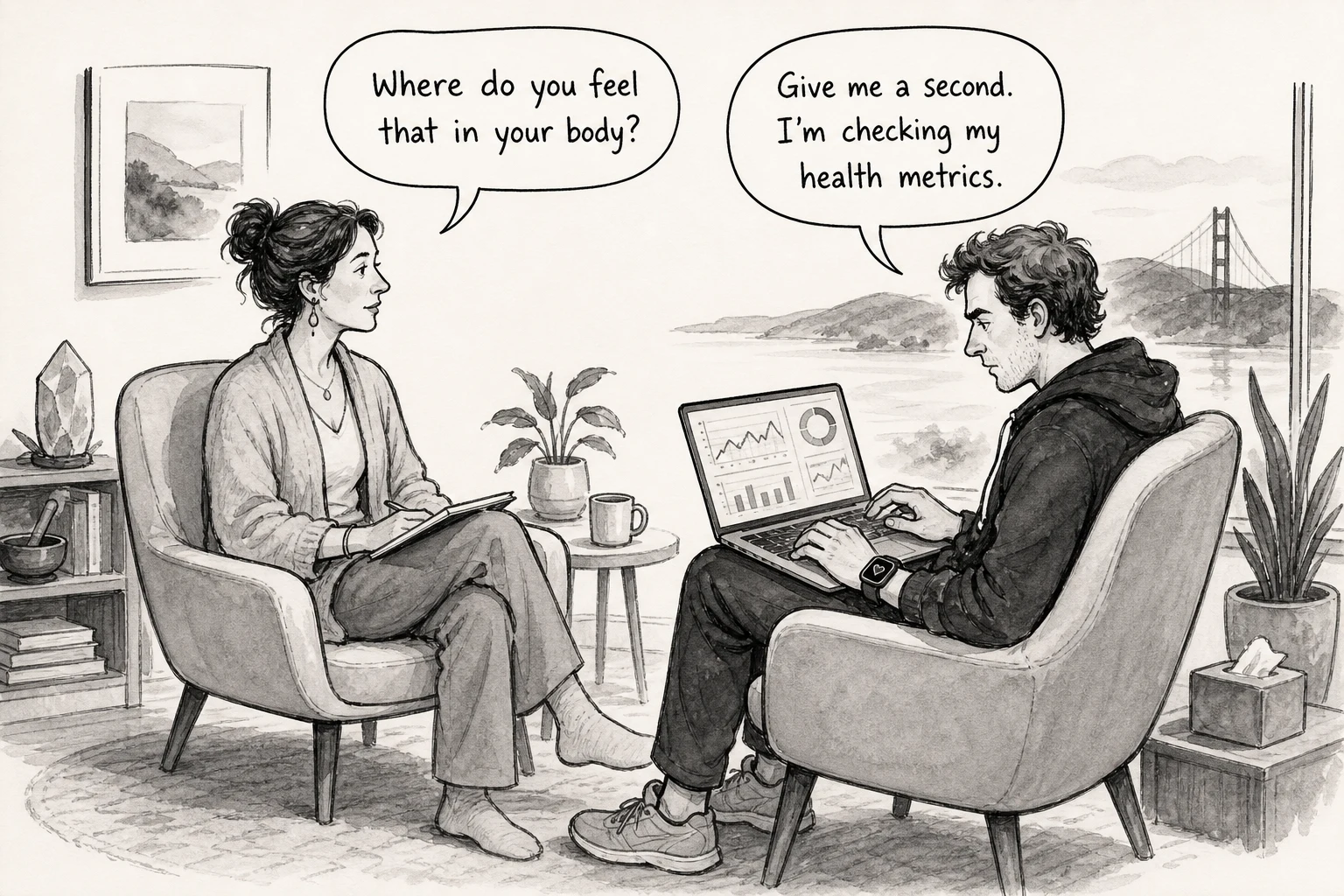
Many people, particularly here in the Bay Area, navigate the world almost entirely through intellect (a left-hemispheric perspective, as Iain McGilchrist would say). Clenching has become the water they swim in.
They may not notice the clench because it is their only reference point, and the world pays them well for the abstract thinking that it enables. As Ken Robinson joked, the body becomes a way of getting their head to meetings.
If you’re in this category, start with the beliefs or rumination loops that create unease, then notice how they arise alongside tension in the body.
Begin with experiments that bring you into your senses and sharpen your sensitivity to anything that happens below the neck (this allows you to catch subtler clenches over time).
2. The Trap of Feeling Too Much
Increased sensitivity is a superpower that requires an increased capacity to be with the intensity.
I think of the scene in Man of Steel, where young Clark Kent’s superhuman hearing switches on in the middle of class. It is so overwhelming that he hides in a janitor’s closet, and his mother talks him down through the door: ‘Focus on my voice. Make the world small.’ With time, he learns to be with the high stimulus and realises that it’s a gift.
This sensitivity may enhance your intuitive decision making and lower your tolerance for bullshit. It may even become harder to stay in a job you hate or a relationship that isn’t working because you feel the cost so acutely.
Notice what happens when an emotion feels like too much. Do you retreat into thought loops of blaming others or yourself? Do you dissociate? It's good to know what your patterns are so that you can work with them in real time.
The best skill that those on the more sensitive end of the spectrum can cultivate is grounding, which will build nervous system capacity over time. For this, practices like orienting, extended-exhale breathing and non-sleep deep rest (yoga nidra) are all extremely helpful, and part of what we teach in the Nervous System Mastery toolkit.
Also on a practical note: being in a low-arousal environment (soft surfaces, warm lighting, plants or nature in view) can also make a substantial difference.
3. The Trap of Avoiding Your Emotions
I mean, I get it. It's scary. It feels like there might be an endless torrent of tears and you don't know who you'll be on the other side.
But to paraphrase Anaïs Nin, your life will expand or contract in proportion to your courage. And just twenty seconds of courage can go a long way.
Something I notice is that most people are comfortable expressing either their sadness or anger, but rarely, both. And often many people I work with default to sadness (rather than anger) and need to re-learn how to welcome their anger specfically.
A Cheat Sheet for Feeling Anger How to prepare, feel anger safely, and avoid the common failure modes
#1 Anger Is Essential
If you don’t allow your anger, you will find it difficult to say no, set boundaries or advocate for your needs. Essentially, people won’t trust you, you’ll fall into people pleasing tendencies and likely accumulate resentment over time.
#2 Signs of Clenched Anger
If you notice resentment of others, if you have an active inner critic (anger turned inwards), if you feel a lack of aliveness or dullness (as if you’re living behind a pane of glass) or if you find it difficult to say no to others’ requests.
#3 How to Prepare
Set aside 15-25 minutes, find a private space (unless you have a friend or loved one who is open to holding space and witnessing). Ground yourself, drop into your body, and if you can, connect to the care/presence that the anger is protecting — and specifically where you feel the anger in your body.
Prioritise safety and remove any sharp objects, hard surfaces etc.) Optional but helpful: play an activating track or song
#4 How to Feel Anger
Once you’re connected to the sensation, there are three approaches to try:
Setting a boundary or saying ‘no’, which can be done either pushing as hard as you can against a wall with sound/growling etc.
The ‘it’s not fair/tantrum’ which can be done lying on your back (on a mattress) and pounding the bed/pillows with your fists.
Using a tennis racquet or striking with your forearms onto a pillow whilst making loud sound or saying ‘fuck you’ (surprisingly effective but careful on the vocal chords)
Watch out for shame/judgement arising as you’re doing this, you can try the phrase ‘I am loved in my anger’ or ‘I love my anger’ (whatever feels most supportive to you). Typically, especially in the beginning, either it'll feel fake or the anger will come out kinked. That’s great. You can keep acting angry until it feels real.
You will likely oscillate between being in your head/story and connecting to the somatic sensations. This is also totally fine + normal. Also lower pitched sounds or growls (from lower down in the belly), tend to be just as effective but not cause vocal chord impact in the way that higher-pitched screams can. With practice, the heartfelt sensations of anger will be easier to access, as will the deep sense of care that it comes from.
You will know when something has shifted, as there will typically be either relief, or another emotion will surface (potentially heartbreak, or helplessness) that the anger is guarding against.
#5 Failure Modes to Avoid
Being aggressive towards others. If you’re blaming someone else, you’re not taking responsibility but projecting how you feel onto someone else.
Disembodied raging/screaming which may feel cathartic but likely won’t create the associations of safety you’re looking for. Rather let the movement arise from the core of your body (often the belly).
Overriding yourself ~ the goal is to re-pattern your system so that anger is safe to express, and that you are loved in your anger.
Core takeaway: to the degree that you can ground and feel connected to yourself (or connected to what you deeply care about that the anger is protecting) before/during/after the anger practice, is the degree that the anger will, over time flow more naturally.
I've spent the last few years exploring emotional territory that I previously wouldn’t have touched with a ten foot barge pole. Anger, shame, helplessness, terror… and time and time again these deeply contracted places open up into profoundly meaningful experiences where I feel more connected, more integrated, and more fully myself.
Above all I would offer to take it slow, be gentle and trust that you will be brave enough to meet the moment when you’re ready.
4. The Stoicism Trap
This is one I see often (and it was me for a long time). Aspiring stoics or long-term meditators, often those practicing with vipassana or forms of mindfulness, have figured out a way to witness emotions from arm’s length. This can often lead to peace, but also a state of feeling less aliveness and being triggered by seemingly small things.
I call this the fake equanimity trap. It’s seductive because it feels like an improvement on being trapped in the existential washing machine. Here’s the key difference: mindfully witnessing an emotion is very different to moving towards it with care and compassion.
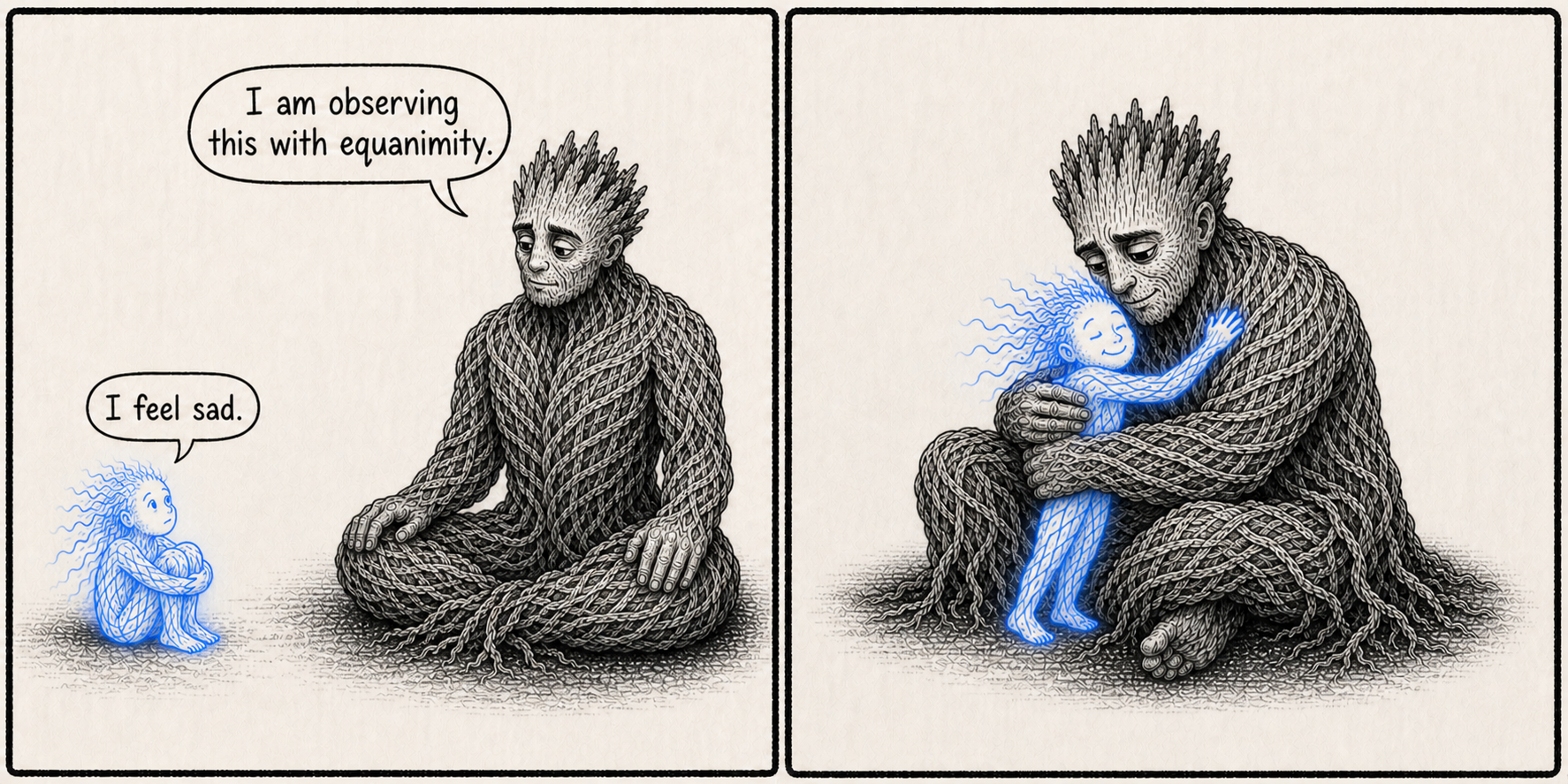
Imagine how you would treat your son or daughter if they came to you with a big emotion. You wouldn’t (I hope) just passively observe them from a distance, you’d give them a big hug. Well it’s no different with your own internal feelings.
5. The Over-Efforting Trap
As my friend Michael Ashcroft likes to say, 'The Appropriate Amount of Effort Is Zero': the act of ‘efforting’ is itself a form of clenching. Trying harder to unclench is therefore a common pitfall.
There is a chasm-wide distinction between setting a strong intention and over-efforting. At a high level, action can happen naturally, without trying.
Examine your frame of reference. If you approach the practice thinking, ‘I need this to work’ or ‘What’s wrong with me? Why can’t I do this?’, that frame is itself a form of clenching.
When the body feels safe and relaxed, the clench opens at its own pace. You can create the conditions, but you cannot force the timing.
Applying our white-knuckled achievement-based orientation toward improving ourselves is part of a wider frame that itself unclenches with time. The growing pushback against optimization culture suggests the cracks are already showing.
You cannot force yourself to let go. Instead, let go of forcing yourself.
Part of the reason that this softens is that with time, we tend to identify less as a separate self in need of fixing (cue buying all the self-help books) and more as something growing at its own pace.
Just as you wouldn't think to judge an oak sapling for not being a 300-foot-tall tree, we are all at our own particular vantage points, growing at different paces and on different trajectories.
· · ·
The Ultimate Unclenching Movie Scene: in one of the greatest Disney scenes of all time, Moana applies a brave C.R.I.S.P. move towards the lava monster Te Kā, allowing it to soften and revealing the generative life force beneath.
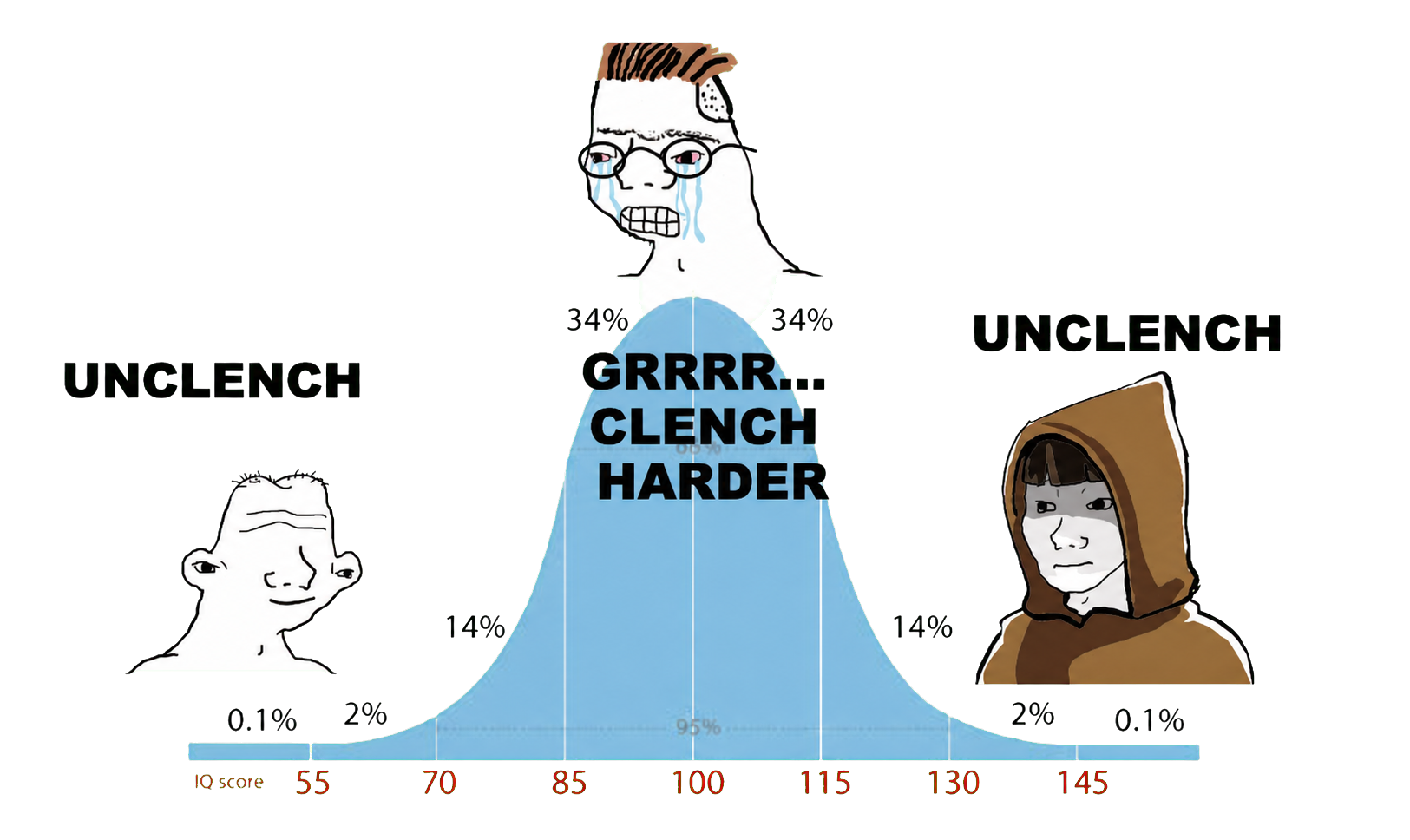
6. The White-Knuckle Midwit Trap
Yes, clenching hard, especially in the beginning of a career, can get a lot of shit done.
But it is the “midwit” approach to productivity, and it often ends in burnout years later. I’ve worked with dozens of formerly clenched founders and executives.
Changing the source of your motivation usually involves a transition period. You may feel as though you have lost your edge; I liken this to the process of ‘deschooling’.
Deschooling is the decompression period children undergo after leaving mainstream education. They may do little for weeks or months before their curiosity returns. Then they become super-learners, devouring books and starting projects for fun rather than on command.
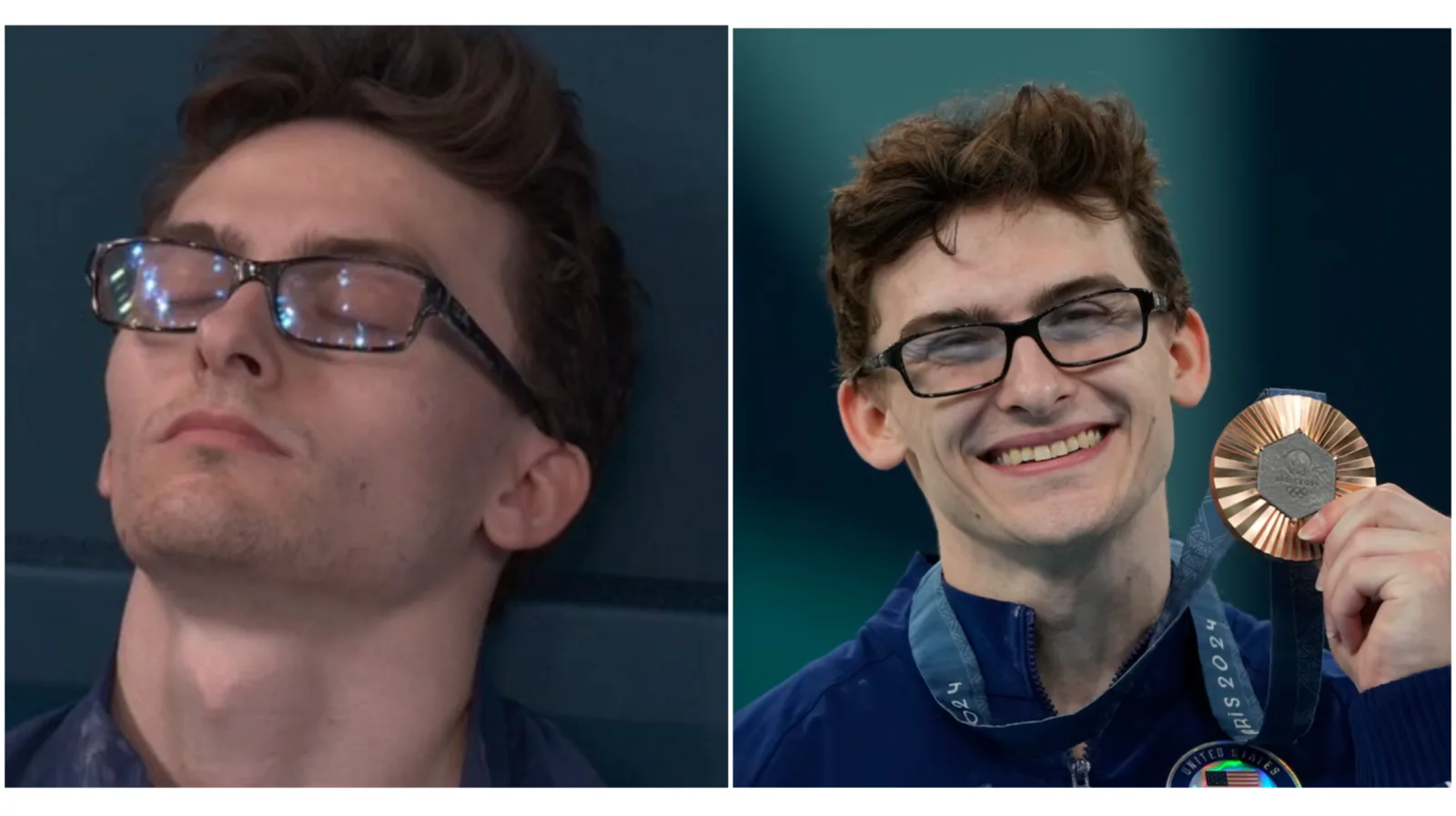
Unclenching can be a powerful performance enhancer.2020 Take Stephen Nedoroscik, the “pommel horse guy” of the Paris Olympics: after five hours of waiting to compete, he sat with his eyes closed, doing breathing exercises and visualizing his routine, then stood up and won bronze.
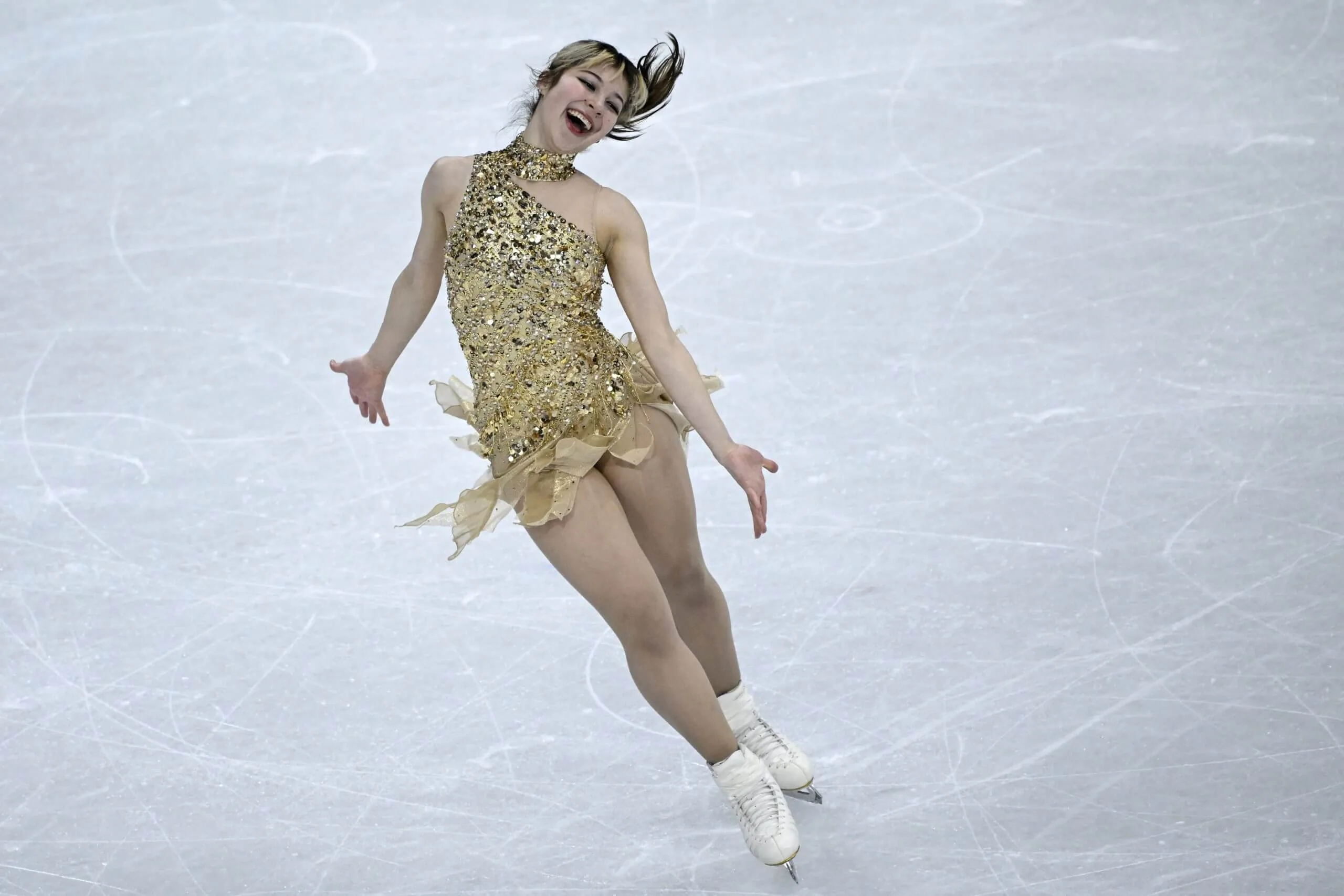
Or Alysa Liu, whose father poured $1m+ into her career at age 13. The extreme control and regimen helped to mold a teenage prodigy, but came at the cost of her agency, curiosity, pleasure, or any life beyond skating. So at 16 she got tired of being under the clenched grip of her father and quit for two years to travel, study, play, and learn.
Eventually, her curiosity for skating returned. She agreed to come back only on her own terms: no strict control of her food, and a say in the music and choreography.
A few years later, in February 2026, she won Olympic gold in Milan at age twenty, joyfully crushing her competition and treating the ice as her canvas.
7. The Unclench Everything Trap
Unclenching has an optimal pace, yet the temptation to force it is strong. I have been guilty of this.
Titration works wonders: move gradually, leaving time to integrate and recover.
You can force some clenches open with psychedelics or holotropic breathwork. But without safety, the clench will return once ordinary consciousness resumes.2121
For most people, life will give you plenty of opportunities to notice where and how you clench. If that is not the case (perhaps you are living in a monastery), I would recommend one of the following: entering a long-term intimate relationship, starting a business or having kids. All three are superb arenas for unclench training.
IV. What Does Unclenching Progress Look Like?


Level 1: Default Mode
Default Mode Stage → running on default mode where reactivity runs the show. You don't realise you're in a game. Others perceive you as emotionally volatile, distant or shut down.
Internal narrative → "why is the world so unfair? What did I do to deserve this? It's the fault of [external person or situation]"
Relationships → attract partners that mirror reactive tendencies. Reactive tendencies clench against intimacy, meaning that lasting fulfilling relationships are challenging.
Strategies → addictive coping strategies provide temporary relief from clench-induced suffering, but don’t last. There will likely be many crutches, either in the form of substances or behaviors (porn, sugary food etc.)
Core Challenge → there's insufficient curiosity about what's happening internally. The pain hasn't yet been enough to provoke real change. Unfortunately, often it takes a burnout, breakup, personal loss or a health crisis to create sufficient humility.
How to Progress → empowering practices and discipline help at this stage to increase a sense of 'self-authorship' as well as sincere inquiry along the lines of asking 'how might I be complicit in creating the conditions I say I don't want'.
Level 2: Unclenching Novice
Early Agency Stage → you start to realise that you can influence your internal state. The first crack of awareness appears. Still reactive, but now there's a witness. This creates more confidence and amplifies curiosity.
Internal narrative → "wait... maybe I'm contributing to the clenching. Maybe I can do something about it. Perhaps I don't have to believe everything I think."
Others perceive you as → still reactive... but there are moments of self-awareness that weren't there before. People notice you sometimes catch yourself mid-clench.
Relationships → you begin taking responsibility for your side of conflict, even if you still sometimes blame first. After an argument, you notice: "Aha… my reaction was disproportionate to what actually happened. Was I clenched?" As a result, repair conversations and moments of intimacy are more accessible.
Strategies → you recognise the tension in your body as you're doom-scrolling. The half-life of reactivity is still long, but you can see it happening, the more you notice the more the auto-clench reflex starts to break down.
Core Challenge → awareness without change. You can see the pattern but can't reliably interrupt it (which feels frustrating and adds to the clenching)
How to Progress → move from noticing to actively running experiments (see above) Try one body-based practice and track what happens. The shift to Level 3 happens when curiosity overtakes frustration.
Level 3: Unclenching Practitioner
Active Experimentation Stage → Now you're actively running unclenching loops for yourself. You track which practices actually work for you (maybe cold showers help, but meditation before coffee makes you anxious).
Internal narrative → "Wow, this is fascinating, look at all the various ways I've been reacting and defending against my emotions. I wonder what else is there to discover?"
Others perceive you as → More grounded, but also sometimes more sensitive to environments or humans that lead to dysregulation. At times, this can feel disorienting and you might seem like you're "going through something" to others.
Relationships → You can catch clenching at 2/10 instead of 9/10. During a heated conversation, you notice and say to yourself: "Oh, I'm getting defensive." The Reactivity half-life is dropping from days/weeks to hours. You might need to pause in conversation more often, but when you come back, you're more present.
Strategies → Coping mechanisms become conscious choices rather than automatic defaults. You have a growing toolkit and know which practices work for specific situations.
Core Challenge → It sometimes feels like you're going backwards. More sensitivity means more feeling, and less guarding means more vulnerability. The increased awareness can be overwhelming before integration and capacity catch up.
How to Progress → begin to explore and embrace underlying feelings that are being clenched against. Grounding practices help but eventually you need to make the move towards welcoming and feeling the underlying emotions.
Level 4: Unclenching Adept
Integration Stage → the unclenching skills that once required conscious effort are becoming automatic. Your default state is easeful and the underlying emotions are generally welcomed. You notice increased sensory clarity and unexpected ripples of joy in ordinary moments and your half-life of reactivity has shrunk to minutes.
Internal narrative → “I feel like good things just seem to be happening, but I don’t know if I can take the credit”
Others perceive you as → calm yet warm, present but not intense. People feel safe around you and remark that you're "grounding to be around"
Relationships → you can hold space for others' activation without getting pulled into it. Conflicts become opportunities for deeper connection and aliveness rather than threats to be avoided.
Strategies → unclenching that once required conscious effort now happens automatically. Someone might deliver harsh feedback but you’re able to receive it with appreciation.
Core Challenge → subtle identification with being "the unclenched one" — a new (superior) identity can form around your progress that itself becomes surface area for reactivity. You may also avoid situations that threaten your hard-won equilibrium.
How to Progress → let go of the identity of being ‘unclenched’. The shift to Level 5 involves loosening your identification and reducing the surface area of self so there's less to defend.
Level 5: Unclenching Master
Master Stage → emotions arise, are felt fully moment to moment and pass through without leaving residue, such that there’s almost no lag between experience and integration. You have opened into secure attachment with reality.
Internal narrative → "Everything is workable. I can’t believe that I get to have this experience. What a privilege."
Others perceive you as → people can't quite articulate what's different, but they feel the aura and wish to be around you.
Relationships → deep intimacy with everyone and everything. You can be fully seen without flinching because there’s no longer anything to defend or clench against or story about what it means.
Strategies → there's less surface area of identification to be caught in. Perhaps you notice excitement when something challenging arises, because you know that the other side holds even more freedom.
Core Challenge → the work at this stage is staying open and continuing to deepen in devotion to the people, work and place around you and it feels like a constant joy.
How to Progress → This is no destination and progress is inevitable. In the moments when subtle clenching still arises it is understood that the suffering itself is a dense bundle of love.
1. Your Relationships Have Greater Depth
Running unclenching loops can make you more approachable and better able to turn arguments into productive conflict.
Why? Because you’re more able to let in the everyday heartbreaks of any meaningful relationship.
You may even seem more inviting; strangers may start more conversations with you. Perhaps the ‘introvert’ was a clenched extrovert all along.
Art of Accomplishment founder and executive coach Joe Hudson talks about the Groundbreakers 'facelift': after a week participating in their intensive off-menu retreat, participants look as if they've had a facelift because so much tension has been resolved from their default expression.
2. Where Did My Inner Critic Go?
As an n-of-one, I’ve spent the past decade running versions of unclenching loops, although I did not call them that at the time. My inner critic has shrunk from an abusive roommate who dominated most days to a presence in less than one percent of my lived experience.
This is hard to describe, but my thinking has softened. Thoughts feel dialled down, as though they are happening in another room that I may choose to enter. Much of the time my experience is more like having a helpful friend offering the occasional idea or suggestion. I once spent 10 days in a dark room because I now very much enjoy my own inner dialogue.2323
3. Increased Agency
Running unclenching loops creates a high agency virtuous cycle, although it takes some agency to run one in the first place (as opposed to blaming external circumstances).
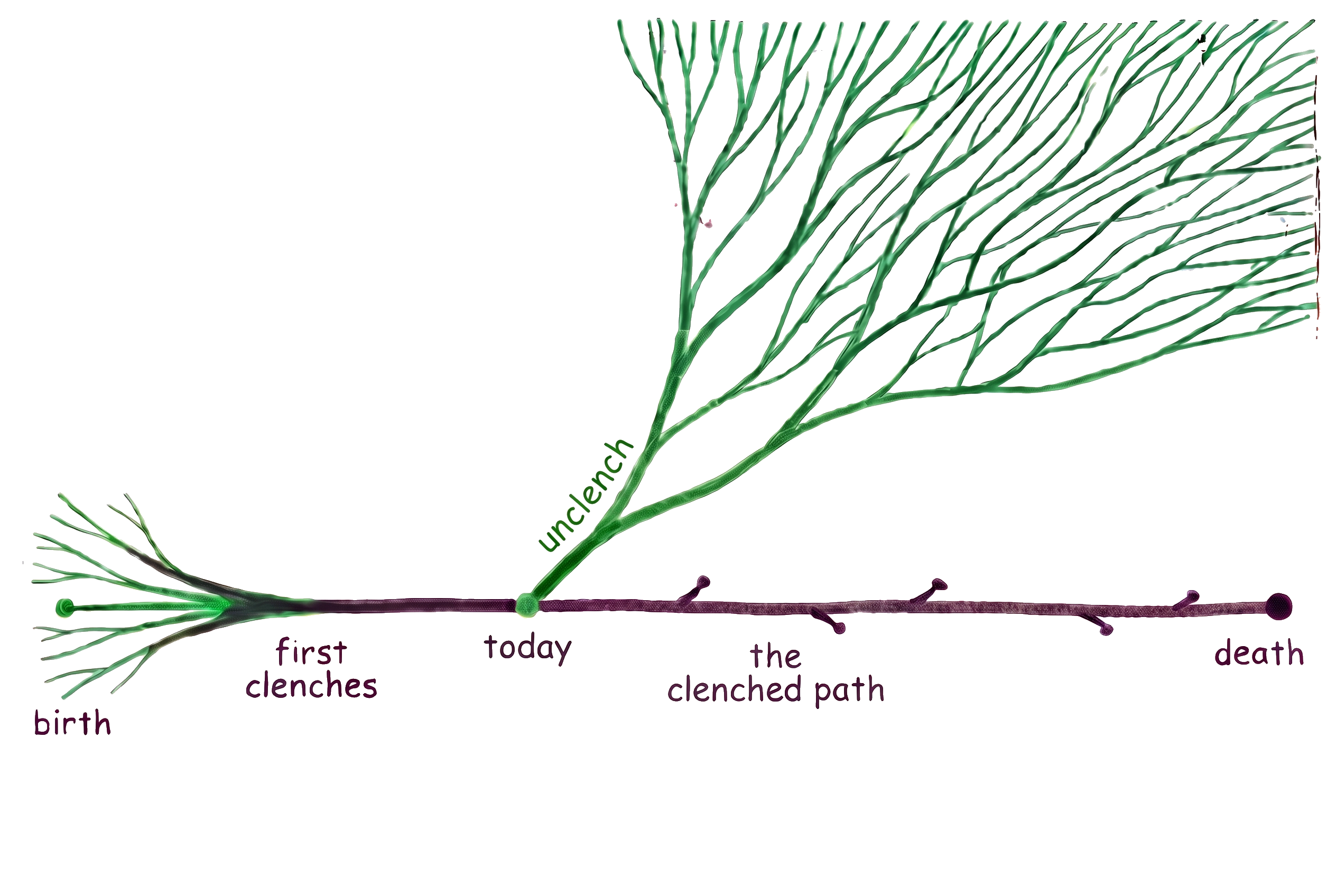
Specifically, it develops your ability to run the loop, try different experiments and escape local-optimum traps.
Many agency bottlenecks begin as attempts to avoid emotional discomfort, which then trigger further avoidance and low-agency patterns.
You may also feel a greater sense of integrity in the system. There are fewer internal tensions created by conflicting parts (part of me wants this, another wants that) and as a result decisions come more naturally.
4. You Become the Person Your Future Self Would Be Proud Of
Imagine that at midnight tonight, the universe forks: two identical versions of you wake up tomorrow. They have exactly the same body, memories, relationships, bank balance and circumstances.
The only difference is that version B of you clenches ten percent less and dedicates time to running unclenching loops. Nothing changes overnight, but with time version B takes on more challenging conversations, is less likely to get stuck in rumination and finds that connection in relationships feels more effortless. Over a year or a decade, the difference compounds.
Version B takes bigger risks, steps into more difficult conversations, and knows there is a default background of ease available in any moment, whatever else is going on. This is the path to becoming the person your future self would be proud of.
THE END
p.s. if you made it this far, congratulations! You’re likely a very good fit for this workshop that I'm running on September 17 (last year we had to cap at 1000 people).
p.p.s. if you found this valuable, consider forwarding onto a friend: howtounclench.com
· · ·
Free live workshop · September 17
Design Your Own
Unclenching Loops
Practical tools to unclench your nervous system: join me live on Zoom, practice together, and leave with a loop you can run in your own life.
Notes
The word anxiety derives from the Latin verb 'ango', quite literally meaning ‘to constrict’. Cicero characterized it as a ‘constricting disorder’.
↩Without realising it we also design our lives around unclenching behaviours: a glass of wine to help unwind the end of a work-day or loosen up when socializing.
↩Roosevelt is often credited with saying that comparison is the thief of joy, but actually clenching is the true thief of joy, and sometimes it shows up as comparing to others.
↩If you’re curious what it’s like to increase the uncertainty aperture, read Aldous Huxley’s doors of perception in which he took four-tenths of a gram of mescaline.
↩Technically Mike proposes that clenching 'stabilizes neural patterns', reducing their dynamic range, which means fewer alternative patterns or options remain easily accessible.
↩I created ‘Clenched Creatures’, a playful project illustrating 52 patterns of clenching as mythical animals.
↩I believe the first four stages of grief (denial, anger, bargaining and depression) are just four ways that we clench against the intensity of grief.
↩It's no exaggeration to say that this experience altered the trajectory of my life.
↩I believe one of the reasons we respond so strongly to children is that we recognise their emotional freedom and absence of clenching
↩In Chinese (especially Taijiquan), they have a great definition of unclenching. Their word for it is 鬆 or sōng, which translates to loosened, released, easy and alive. 鬆 essentially means letting unnecessary muscular tension fall away without becoming limp or collapsing, and from here Wu wei (effortless action) is possible.
↩a phrase coined by meditation teacher John Churchill
↩This dovetails with emerging research on awe and wonder and its tangible health benefits.
↩Some areas tend to be more clench-prone, including the neck, jaw, mouth, armpits, diaphragm and psoas.
↩Some that I have experienced and wholeheartedly recommend include Daniel Thorson's Arc Network, Joe Hudson's Connection Course, Pranab's Attn Co-pilot at work and the relational dojo practice that I co-created as part of the Nervous System Mastery cohort experience.
↩There are some executive coaches (unclenching co-pilots) out there who can guide and design unclenching loops with you (I’ve seen Sasha Chapin, Stephen Zerfas, Alex Olshonsky and Derek Haswell do this work first-hand).
↩You can read this unclenching log from Jhourney participant Nadia, outlining the techniques and experiments that she ran in order to unclench her way to an experience of a "cessation" (for context, cessation is an experience presumed to require thousands of hours of meditation practice to reach).
↩I know what you’re thinking. Yes, the same is true of orgasm.
↩If you don't have easy access to a sauna, you can cycle between a hot bath and a cold shower and still receive some of the benefits.
↩This tracks with my experience, especially from the cello and double bass which have a unique capacity to turn me into an unclenched teary puddle... and this may be partly due to the way that bowed strings can sustain, swell, tremble and slide through pitch somewhat akin to a human voice on the edge of crying.
↩For those who are still skeptical, I get it, and there's a great podcast episode called 'Enjoy Over Manage' with Joe Hudson and Brett Kistler where they share many more concrete examples for how optimizing for enjoyment (i.e. unclenching) counter-intuitively leads to better outcomes and performance.
↩The longer I spend on my own unclenching journey, the more I prefer gentler, more effortless approaches.
↩Listen to my conversation Bill Plotkin describing the five stages of 'soul descent'
↩I'm not alone in this. I interviewed River Kenna, who also described how he was able to use unclenching practices to go from experiencing an incessant inner critic and suicidal ideation to removing almost all negative self-talk.
↩I suspect fasting has a role in initiatory experiences because when you fast you activate ketosis which is a cleaner fuel for the metabolic system to run on
↩Fun fact: my wife and I did a guided MDMA journey together back in 2022, at the end of which she decided that she did want to have kids (having previously not wanted to go down the parenthood path), and we now have a beautiful five-month-old daughter.
↩Go Deeper: Listen to my conversation with Marcela Ot'alora, the principal investigator during the MAPS trials, on the value of preparation and integration for MDMA-assisted therapy.
↩
The Unclenching Library
1. Unclenching FAQ
Q1. Surely you don’t mean ALL suffering?
I realise it sounds like an overclaim, and I don’t wish to withdraw compassion from those who are deeply suffering (quite the opposite) but allow me to share a few extreme examples to illustrate:
What about someone starving of hunger, that’s not clenching. Counter-example: monastics would routinely fast for weeks in order to access very refined states of consciousness.
What about someone who is experiencing physical pain in real time? Look at the BDSM community, where they learn the practice of transmuting intense pain into intensely pleasurable experiences
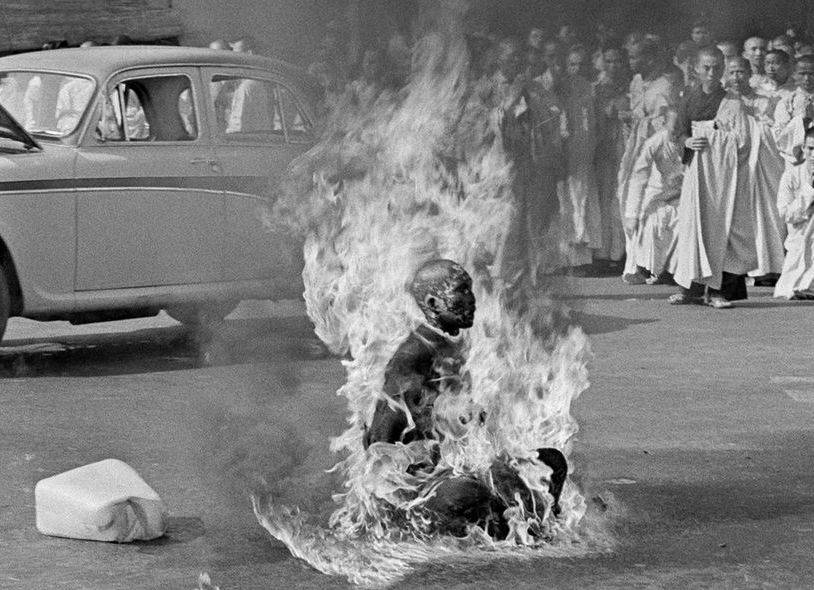
What about someone dying a painful death? I recall being deeply moved by the Vietnamese monk Thích Quảng Đức rotating a string of wooden prayer beads while a colleague emptied the contents of the petrol container over his head. He then struck a match and dropped it on himself. Flames consumed his robes and flesh, and black oily smoke rose from his burning body. Now I can’t pretend to know his internal experience, but as he burned he never moved a muscle, never uttered a sound; his outward composure in sharp contrast to the wailing people around him. After about ten minutes, Duc’s body was consumed by the fire and it eventually toppled backward onto its back.
Q2. Is unclenching practice just meditation?
They are clearly related. I might get in trouble for saying this, but in my view, any meditation practice is successful only to the degree that it allows you to unclench. There’s a lot of McMindfullness that doesn’t really help in the long term, and there are also many practices or ‘moves’ that create the conditions for unclenching but are generally not considered to be typical 'meditation'.
And yes Siddhartha (the Buddha) articulated closely related insights thousands of years ago: unclenching maps onto dependent cessation. Here’s how the ideas overlap:
| Buddhist term | Unclenching translation |
|---|---|
| vedanā | A pleasant, unpleasant, or neutral feeling appears |
| taṇhā | Crabby urge to clench towards/away from it |
| upādāna | Clenching intensifies (gripping, identifying or managing) |
| bhava | clench turns into a way of being and acting |
| dukkha | Resulting experience of reduced aliveness and suffering |
| nirodha | Happens when the grabby cycle stops being fed |
If this frame resonates, wonderful! But Pāli terms such as taṇhā and dukkha may be barriers for modern readers and practitioners.
I agree with Nick that the ancients already solved these problems but that the main messages got lost in translation along the way.
Q3. Is unclenching just like doing therapy?
Again, they are related. Skilled somatic therapists can be superb co-pilots in the unclenching process. I’m an advocate of Hakomi, FBR breathwork, Aletheia Internal Family Systems, NARM, and Somatic Experiencing, although finding a practitioner you trust and feel safe with matters far more than choosing the right modality.
Q4. I still don’t understand the downside of clenching.
When you clench (in small or large ways), you are expending more energy than is strictly necessary. It's a bit like an insurance policy: you're spending extra energy in exchange for greater predictability. As such, you are also narrowing down your options, meaning that you will likely react in knee-jerk ways.
I notice it in myself: on clenched days my thinking narrows to binaries, and disagreement starts to feel like threat.
Q5. How is clenching related to addiction?
What is addiction? Addiction is a clenched state where the thing you’re addicted to provides a temporary means of unclenching. For some people this might be heroin, for others sugar or porn, and for others it could even be thinking itself.
Addiction recovery is successful to the degree that it can provide alternative and sustainable means of unclenching (often community, spiritual connection, and a willingness to integrate disowned parts of one’s history)
Q6. How is clenching related to desire?
Naval has this famous pithy tweet:

I actually think he’s mistaken. Clenching onto desire creates the contract of suffering. You can try this for yourself, if you feel desire in your body it feels like pleasure. The less you grab onto it, the more pleasure you feel.
Q7. How is clenching evolutionarily adaptive?
If clenching causes suffering, how did it get passed down through hundreds of thousands of years of evolution?
As Darwinians are fond of saying: evolution doesn't care about you; it cares about survival. That seems to be what gets coded in. It's a bold claim but Mike believes that our ability to create clenches and latches might be how humans won the evolutionary game:
"I suspect humans won due to our ability to freeze sensations. A frozen sensation can be combined with others (imagination), or distilled & given to others (language), or held until it becomes true (Active Inference). But in a world of frozen sensations, there is suffering."
Q8. What about lifting weights, is that clenching?
Yes there is an important nuance here, in this essay we’re referring specifically to vascular smooth-muscle tension – which is different from the skeletal muscle activated by say an olympic squat. In fact the best lifters are able to be maximally contracted but yet relatively unclenched.
Q9. Why do I seem to clench more when I’m tired or hungry?
Amazing question! The answer is connected to something I didn’t have space to get into but is very relevant: our metabolic system and the ‘energy security model’. When we have less available energy in our system, the nervous system becomes more conservative, increasing the likelihood of protective moves (aka clenching).
Counter-intuitively, being highly unclenched is a metabolically ‘high-energy’ state.2424
A manageable energy gap results in sympathetic mobilization (fight/flight) adrenaline, alertness and bracing, also known as hyperarousal. A more prolonged shortfall may produce fatigue, numbness or shutdown (hypoarousal). A clench is actually spending energy to remain clenched, but a latch can be sustained at a metabolic discount.
So sometimes yes, the right approach is to just get some good rest and a protein rich meal.
Q10. What is the connection between clenching and metabolic health
This is a deep topic, but the TL;DR is that clenching can create something of a metabolic death spiral.
More clenching → less blood flow → less fuel and oxygen → less capacity to release → more clenching.
The clench narrows the vessels supplying nearby tissue. Less blood can get through, so the cells receive less oxygen and fuel and clear waste less effectively. That leaves them with less spare energy for the metabolic machinery that restores relaxation.
Mainstream mental health practitioners are rightly starting to pay attention to the role of metabolic health, but very few (if any) factor in the role that clenching plays.
Q11. What is the most efficient way to learn unclenching?
I see two main hurdles: getting clear feedback, and staying motivated long enough to learn.
One surprising answer I sometimes give that is where I first learnt unclenching is in the realm of freediving. Freediving, the act of taking a deep breath and swimming underwater, is essentially high stakes unclenching practice.
Depth is the reward you get for being able to unclench your internal musculature (which allows you to equalise and fall deeper). This objective feedback that comes from releasing tension is invaluable.
Then in terms of solving for sustained motivation: I see this working with either a very big stick or a very big carrot. Life will sometimes provide a very big stick (burnout or a health crisis etc.) but the startup Jhourney have created a delicious carrot promising ‘Bliss on Demand’ in days and combined with an excellent way of teaching it.
Q12. How do you know when a latch has been released?
Because we don’t yet have the technology to map latches, it’s not possible to say for sure, however typically there will be a spontaneous deep breath or sigh, warmth or tingling in the area (indicating blood flow), an emotion moving through (tears, laughter etc.), and generally more sensation where there was previously numbness.
In studies of psychedelic-assisted therapy, researchers observed that those who experienced the biggest lasting shifts had a moment of ‘letting go’ in their sessions. This moment of letting go was, according to this theory, when a latch got released.
In one 2025 research paper, Irrmischer et al. found that among 83 participants receiving psilocybin-assisted therapy, the ability to "let go" (i.e. unclenching) during the session moderated improvements in depression, PTSD, anxiety and neuroticism over three months.
In another 2019 paper, Russ et al. found that "surrender" (i.e. unclenching) at the beginning of a psilocybin experience was the strongest predictor of mystical experience, which in turn predicted long-term positive change.
In other words, the research subjects noticed a transition in which arousal can remain high, but their resistance drops.
Q13. Do psychedelics have a role to play?
I think yes. Some stubborn clenches resist both relentless self-exploration and the sustained presence of another person. In these cases, other tools may help.
I'm an advocate for using them (preferably with a skilled guide in a safe space), especially early in the journey, because they point to what is possible.
Ketamine, psilocybin or MDMA, each with different risks and benefit profiles, can sometimes untangle deeply rooted clenches, especially alongside attuned bodywork.
For those reluctant to explore psychedelic drugs, FBR (facilitated breath repatterning) which uses a circular breathing technique can also be just as potent.
Recent research suggests that psychedelics may produce 'biphasic shifts between constrictive and dilatory vascular responses' (returning to the insight that cycling through clenching and unclenching seems to support the opening of latches).
I spent a long time avoiding ketamine, mostly because of its recreational use, addictive qualities and reputation for being dissociative. But recently, after being able to open a stubborn clench in my lower belly that felt connected to some very early experiences in life, I've changed my mind.
The obvious disclaimer for MDMA is that it's currently a Schedule I controlled substance and can often be cut with various toxic substances, so please be careful and DYOR.2525
And with that caveat, as some of the early clinical trials have indicated, MDMA, when combined with a skilled guide, has the potential to change lives (the phase 3 trials treated severe PTSD).
These substances are non-specific amplifiers. They intensify your inner experience, and you can improve the odds of a beneficial outcome by:
creating a set and setting conducive to unclenching (low stimulus, comfortable, choosing a good playlist is essential)
working alongside a skilled practitioner whom you deeply trust to witness and hold you through some potentially challenging and intense places
clarifying your intention: perhaps it’s to run your own version of the unclenching loop, applying the same C.R.I.S.P. attention or something more personal
setting aside spaciousness for integration following the experience.2626
2. Origins + Possible Mechanisms
i. A Brief Intellectual History of Unclenching
Wind the clock back to 500 BCE and Siddhartha Gautama (aka the Buddha) figured out unclenching. In fact, he called it the Second Noble Truth: that clenching (tanhā in his language) is the root of suffering (dukkha).
And yes, those of you who are familiar with his teachings might correctly point out that reducing tanhā is precisely what Buddhism seeks to train...
In the nineteenth century, psychotherapists pioneered what we now loosely call ‘somatic work’.
Wilhelm Reich argued that chronic psychological defences show up as ‘character armour’: rigid personality patterns. He used breathwork, direct manipulation, and emotional release to dissolve it.
Soon after, his student Alexander Lowen mapped chronic muscular holding patterns into the ‘five character structures’: five clenching styles the body learns, often early in life, to defend against feeling unsafe or unwelcome.
Then, unfortunately, the field of psychotherapy took a turn away from the body and moved more into the realm of 'talk therapy', which can be a helpful first step but, in my experience, rarely addresses the root cause of suffering. It's common to hear of someone going to therapy for a decade without any significant breakthroughs or shifts in their life.
-
 01
01Siddhartha
Early Buddhist teaching links craving and attachment with the arising of suffering.
Four Noble Truths ↗ -
 02
02Edmund Jacobson
Progressive relaxation makes unnecessary muscular tension something a person can notice and deliberately release.
Jacobson’s legacy ↗ -
 03
03Wilhelm Reich
Character Analysis describes defensive patterns that can be expressed through chronic muscular holding.
Character Analysis ↗ -
 04
04Alexander Lowen
Bioenergetic Analysis develops a body-oriented approach to chronic tension, movement and emotional expression.
Lowen Foundation ↗ -
 05
05Peter Levine
Waking the Tiger reframes trauma as incomplete survival responses held in the body, released gradually through Somatic Experiencing.
Somatic Experiencing ↗ -
 06
06Michael Edward Johnson
Johnson proposes that vascular smooth-muscle dynamics may participate in memory, prediction and persistent bodily tension.
Principles of Vasocomputation ↗
ii. How the Body Might Keep the Score
Towards a Biological Mechanism for How Trauma is Stored in the Body
Neuroscientists have recently pushed back against the idea, popularized by Bessel van der Kolk, that the body keeps the score (one article was subtly titled: 'The Body Keeps the Score Is Bullshit').
Neuroscientists such as Lisa Feldman Barrett argue that everything, including trauma, is in our heads. Barrett argues that actually “the brain keeps the score”, essentially dismissing the idea that trauma somehow lives in the body.
Many of these critiques are valid: as of today, there is no established bodily mechanism for storing trauma.
Here's a quote from Professor Andrew Huberman:
“The operational definition of trauma is that some fear took place and somehow gets embedded or activated in our nervous system and shows up at times when it’s maladaptive.”
Note that he says somehow it gets embedded or activated in our nervous system.
To see why this gap matters, go back to the early 1800s.
In that era, physicians knew that diseases spread, but they didn’t understand how or why. They saw fevers sweep through towns. They watched infections spread from patient to patient. But they couldn’t see what was causing them.
So their best theories were guesses: maybe it was bad air, moral weakness or an imbalance in the body’s humors. Some observers, like the physician John Snow in the early 1850s, suspected invisible agents, but no one had actually seen them.
And crucially, microscopes and laboratory methods were not yet good enough to establish that specific bacteria caused particular diseases. Then, in the late nineteenth century, there was a shift that changed the course of humanity.
Improvements in microscopy, staining and culturing made microbes visible and testable. In the 1870s and 1880s, Robert Koch developed methods for linking specific bacteria to particular diseases. Once these pathogens could be identified, researchers had a precise target for prevention and, eventually, treatment.
Once the invisible became visible, the entire field transformed. Right now, in mid-2026, I wonder if we might be on the cusp of a similar breakthrough in the science of trauma.
· · ·
Mike Johnson is a soft-spoken savant. A renegade philosopher and neuroscientist operating outside of academia, he is best known for his theories on 'neural annealing', the 'symmetry of valence' and, more recently, what is in my view his most ambitious theory: 'vasocomputation'.
If those terms are unfamiliar, don’t worry. What matters here is how they relate to the unclenching hypothesis.
Mike’s theory is that vascular tension acts as a special type of memory, which allows the brain and nervous system to store predictions about the world (known as priors).
Everyone was taught in school that the vascular system is just “plumbing for blood”: tubes that transport nutrients and waste.
Mike’s theory suggests this misses the vast majority of what the system does: the vascular system adaptively shifts tension to help neurons compute. In other words, our vascular system is like a giant biological computer, where a single sustained thought is a pattern of vascular tension.
For the trauma story, the key property of these vascular clenches is the ‘latch-bridge mechanism’.
In simple terms, a latch creates a semi-permanent clench, which deprives neurons of blood and further prevents updates. In experience, this becomes a fundamental prediction through which we see the world (Scott Alexander calls this a trapped prior; Sasha Chapin calls it 'Gnar').
A recent study published in Nature appears to support the idea that psychedelics, and in particular serotonin, have powerful vasoactive effects, lending support to the idea that at least some of the benefits of psychedelic-assisted therapy are related to their ability to support unclenching.
3. Speculation Corner
i. Somatic Luck Theory
I have a working theory that unclenching makes you measurably luckier. Here, ‘luck’ combines three factors that unclenching may influence:
Increased Tolerance for Uncertainty: Less contraction creates a sense of inherent safety in the world, which expands your sense of the ‘adjacent possible’, increasing your capacity to sit with ambiguity and giving novel connections more time to emerge → thus reducing the odds of picking a low-risk default path.
Attract High-Integrity Collaborators: Others track the reduced bracing and receptive nervous system state, which signals trust and connection (via micro-expressions, low facial tension and HRV coherence). This leads to more generous assumptions about others' motives, which in turn lowers defensiveness and boosts opportunities.
Repeatedly Uncanny Decision-Making: Individuals holding less tension will naturally gravitate towards choices that aren’t driven by subconscious desires rooted in emotional avoidance. Instead, they tend towards actions with a higher payoff due to state-dependent intuition.
In short, less tension may clear perception, improve decisions, and make life appear to bend luck in your favour.
ii. The Four Clenched Horsemen
There are four so-called 'Horsemen' of major degenerative diseases – the four biggest killers on the planet – and all of them are downstream of inflammation in the body.
“Although there may never be such a single path, mounting evidence suggests a common underlying cause of major degenerative diseases. The four horsemen of the medical apocalypse — coronary artery disease, diabetes, cancer, and Alzheimer's — may be riding the same steed: inflammation.” — Harvard Health Publishing
What's fascinating is that there are clear theoretical mechanisms for how clenching and latches would create the conditions for inflammation, and therefore perhaps be an upstream root cause for the leading causes of death among humans.
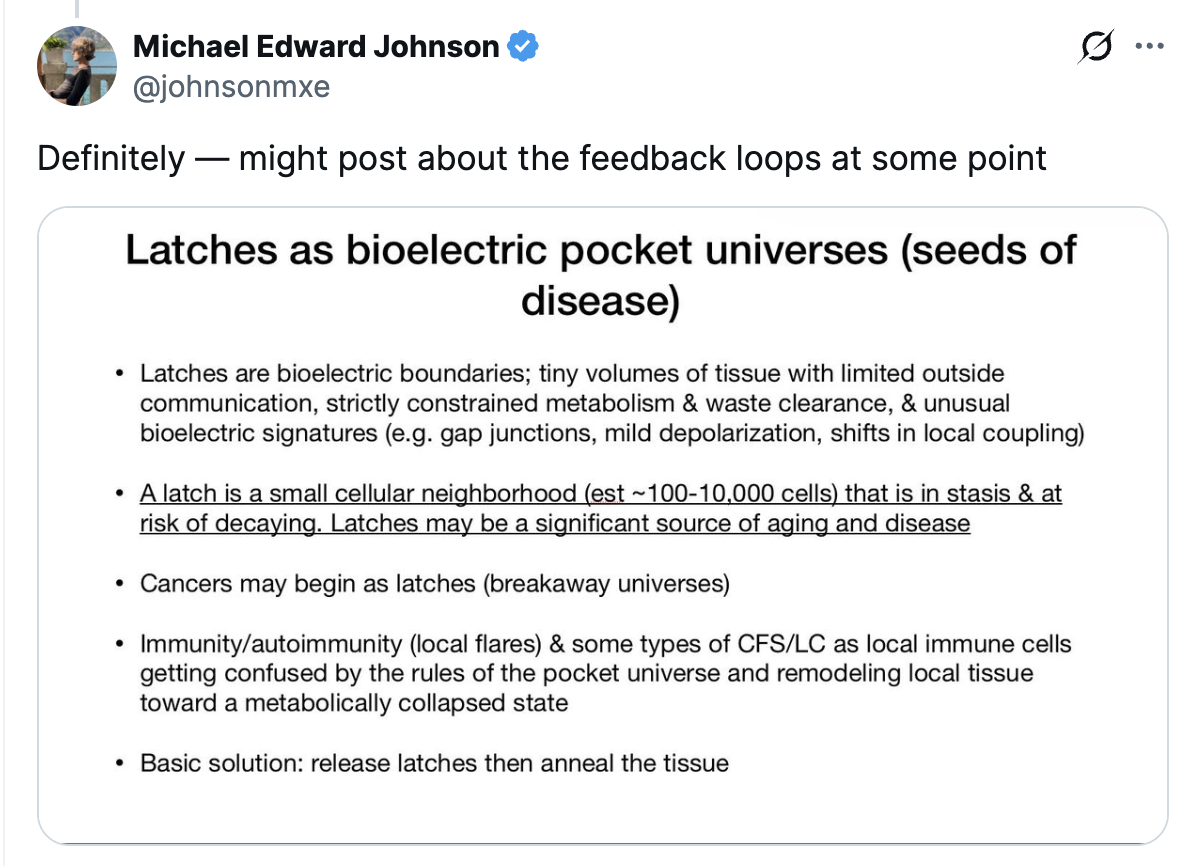
This is highly speculative. But if there were even a one-percent chance that vascular latches help sow the seeds of four leading causes of death, the hypothesis would deserve rigorous study.
iii. The Potential Role of Bioelectricity
Dr. Michael Levin has shown that bioelectricity is used to send signals within organisms and help them maintain coherence. And recently it has been demonstrated that all living cells emit small amounts of light (biophotons).
Levin’s research suggests something wild: that agency, the capacity to sense, decide, and act, isn’t exclusive to humans, or even to brains. Cells and tissues exhibit a kind of decentralized intelligence.
“Agents can combine into networks, scaling their tiny, local goals into more grandiose ones belonging to a larger, unified self.” — Dr. Michael Levin
This is astonishing. There may quite literally be something it is like to be a lung cell.
Levin’s team has also shown that cancer cells are often electrically disconnected from the body’s bioelectric field, visible via fluorescent voltage-sensitive dyes.
In this light, cancer isn’t just uncontrolled growth: it’s a kind of cellular dissociation. A forgetting of the larger coherence. A soloist who’s lost the key.
What makes this story even more compelling is that your body is awash in bioelectric gradients.
These voltage patterns are foundational to healing, tissue regeneration, and even embryonic development (possibly also disrupted by high EMF environments). Your cells aren’t only responding to chemical cues: they’re listening to bioelectric signals.
And Levin is attempting to decode this language: to read the score that cells use to know who they are, where they belong, and what song they should be singing.
What we call “love” (or “safety”) may literally be a bioelectric signal. The heart produces the body’s strongest rhythmic bioelectromagnetic signal. At the body surface, its electrical signal is typically tens of times larger than the brain’s. When coherent, it radiates in rhythmic waves through tissue and space.
I speculate that the practice of loving kindness (what Buddhists call "metta") might be able to up-regulate coherence in living organisms, which in turn creates the conditions for the latches to open and for the cells to reconnect with the broader bioelectric field.
Could loving presence send a signal that helps latched tissue loosen and restore healthier patterns?
I don’t know. These questions seem worth exploring, however, and advances in AI may soon make them scientifically testable.
Upcoming Cohort: Enrollment doors close Sept 25
Learn more about Nervous System Mastery
A 5-week cohort based training where you will get to run experiments, rewire your clench response and practice in a community of curious humans. Read student outcomes here.